

Standard Waldorf rockers work fine for a toddler, but once your child hits four or five, the small size stops making sense. That's when parents start searching for an xxl waldorf rocker, something built to handle a bigger, heavier child without becoming pointless furniture within a year. If you've been comparing listings and wondering why sizes and prices swing so wildly between sellers, you're not alone.
An XXL Waldorf rocker is simply a scaled-up version of the classic wooden rocking arch, longer and wider than the standard model, designed to support older kids, taller frames, and rougher play without tipping or straining at the joints. The extra length also opens up new uses: a rocking boat, a bridge, a bench, or even a plank for balance games, well beyond the toddler years.
In this guide, we'll break down what actually separates an XXL rocker from a regular one, what dimensions and weight limits to look for, and which wood quality and construction details signal a piece built to last. We'll also cover how to judge sizing against your child's age and your space, so you can compare options with confidence instead of guessing.
Why an XXL Waldorf rocker is worth the investment
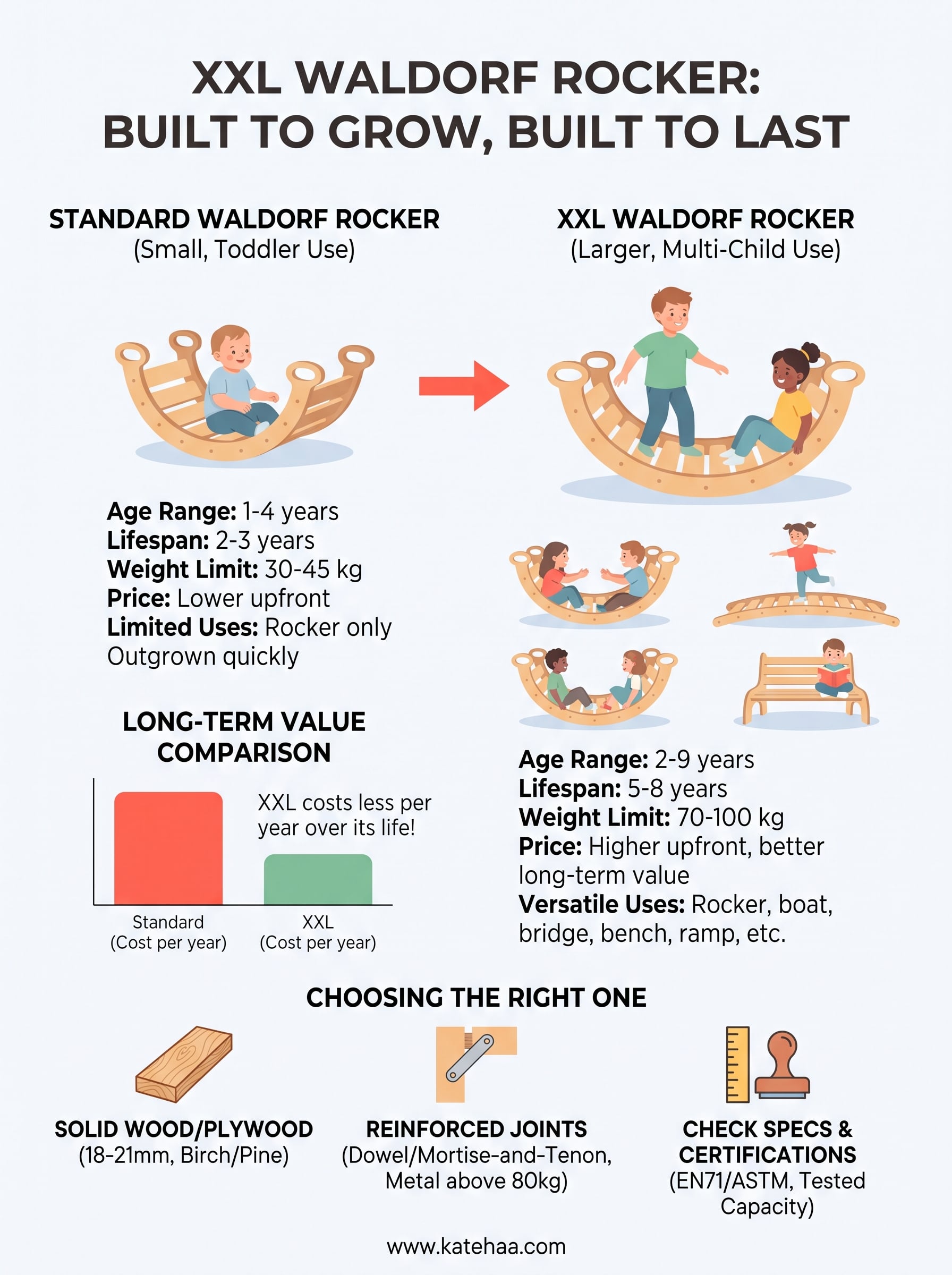
Most families buy their first Waldorf rocker when a baby starts pulling up to stand, somewhere around eight months to a year old. That first rocker usually earns its keep for about two years before a toddler outgrows the arch, the rungs feel too close together, or the frame starts creaking under a heavier body. An xxl waldorf rocker, sometimes called an oversized Waldorf rocker, changes that math entirely. Built with a longer arch and wider base, it keeps working from toddlerhood well into elementary school, often stretching a single toy's useful life from two years to six or more.
A bigger rocker isn't a bigger price tag for the same toy, it's five extra years of play squeezed out of one purchase.
Built for weight, not just height
Size matters, but weight capacity is where cheaper rockers actually fail. A standard rocker rated for 40 kilograms might survive a five-year-old's jumps for a few months before the joints loosen or the wood starts to flex under strain. XXL models use thicker structural wood, usually 18mm to 21mm plywood or solid pine, paired with reinforced joints that carry 80 to 100 kilograms without wobbling. Look for models tested against the EU's Toy Safety Directive, which requires manufacturers to verify structural stability under real load, not just at the showroom weight limit printed on the box. That extra strength matters most once a child starts jumping, standing, or letting a sibling climb on at the same time, situations a smaller frame was never engineered to handle.
One frame, several pieces of furniture
Length is what unlocks new uses a standard rocker can't offer. Flipped upside down, an XXL rocker becomes a rocking boat wide enough for two kids to sit facing each other. Laid flat between two chairs, it works as a balance bridge or a low bench during quiet play. Some families use it as a bookshelf ramp, a puppet theater base, or a plank for obstacle courses built alongside other Montessori climbing pieces. None of these setups work on a toddler-sized rocker, simply because there isn't enough surface area to support the play, and that versatility is a big part of what people mean when they ask about a Waldorf rocker board rather than just a rocker.

Fewer replacements, less waste
Replacing furniture every year or two adds up, both in cost and in the wood, packaging, and shipping that goes into producing another toy. Choosing one well-built XXL rocker instead of two smaller ones over the same stretch of childhood means less spent overall and less material wasted per year of play. Here's a rough comparison based on typical listings:
| Feature | Standard Waldorf Rocker | XXL Waldorf Rocker |
|---|---|---|
| Typical age range | 1-4 years | 2-9 years |
| Useful lifespan | 2-3 years | 5-8 years |
| Weight capacity | 30-45 kg | 70-100 kg |
| Average price range | €90-€200 | €150-€300 |
| Approx. cost per year of use | €35-€70 | €25-€40 |
Yes, the upfront price is higher. But divide that price across the years a family actually uses it, and an XXL rocker usually costs less per year than replacing a smaller one halfway through childhood. For families with more than one child, the math tips even further toward buying the larger size from the start, since a five-year-old and a two-year-old can share the same frame at the same time without either one outgrowing it.
How to choose the right XXL Waldorf rocker
Picking the right rocker means looking past the photos and reading the specs sellers sometimes bury at the bottom of the listing. Start with the wood itself: solid birch or pine holds up better under repeated flexing than particleboard or thin plywood, and it won't sag after a summer of heavy outdoor use. Sanded edges, rounded rungs, and a non-toxic water-based finish matter just as much as the wood grade, since kids grip and chew on these surfaces for years, not months.
Check the joints before the price tag
Joints fail before wood does. Push on a floor sample if you can, or ask a seller for close-up photos of the connection points before buying online. Look for these details:
- Mortise-and-tenon or dowel joints rather than glued butt joints, which loosen under repeated rocking
- Metal reinforcement at stress points on models rated above 80 kg
- A rung spacing of roughly 20 to 22 cm, wide enough for growing feet but not so wide that a toddler slips through
- Visible certification marks (EN71 in Europe, ASTM F963 in the US) printed on the box or listing, not just claimed in the description
If a seller can't show you the joint construction, assume it's the weak point.
Match the rocker to your space
An XXL frame needs real floor space, both for the rocker itself and for the arc it swings through. Measure your play area before ordering, not after the box arrives. A rocker that's 100 cm long needs closer to 150 cm of clearance once a child is actively rocking or flipping it into a bridge position. If you're tight on square footage, some brands, including KateHaa's rockers with slides and ramps, fold flat or nest against a wall when not in use, which matters more in a city apartment than in a house with a dedicated playroom.
Compare across sellers, not just listings
Price differences between two similar-looking rockers usually come down to wood thickness, finish quality, or where the item ships from. A rocker priced 30% below the market average is rarely a bargain once you factor in thinner plywood or unsanded rungs that need reworking at home. Read the material specs line by line, request the weight-tested capacity rather than a stated maximum, and check whether assembly hardware and tools are included, since some budget listings charge extra for what should come standard. A few extra minutes of comparison here saves a return shipment later, which with oversized wooden furniture is neither cheap nor simple.
Comparing sizes, weight limits, and age ranges
Sellers rarely agree on what "XXL" actually means, which is why two listings labeled the same way can differ by 20 or 30 centimeters. A large Waldorf rocker typically runs 90 to 100 cm long, while true XXL models stretch to 110-130 cm, with widths between 45 and 60 cm at the base. Height matters too, since a taller arch sits a bigger child higher off the ground, which changes how confident they feel standing versus sitting. Before comparing prices, pull the exact length, width, and height from each listing rather than trusting the size category alone, since "XXL" is a marketing term, not a fixed standard.
Reading the size specs correctly
Length tells you how much rocking motion the frame allows, and width tells you how stable it feels under an active child. A narrow base under a long arch tips more easily, especially once a five- or six-year-old starts standing rather than sitting. Check the gap between the two side pieces as well, since that measurement determines whether the rocker fits through a doorway or up a narrow staircase without disassembly. Manufacturers list these numbers for a reason, and skipping them is the most common cause of return requests on oversized wooden toys.
Matching weight limits to real use
Weight limits printed on a box often reflect a static test, not a child jumping or two siblings climbing on together. Look for a tested weight capacity stated separately from the maximum, and treat anything under 70 kg as suitable for a single younger child rather than a shared family piece. Below is a rough breakdown of how size, weight limit, and age range typically line up across the market:
| Rocker Size Category | Length | Weight Limit | Typical Age Range | |---|---|---| | Standard | 60-80 cm | 30-45 kg | 1-4 years | | Large | 90-100 cm | 50-70 kg | 2-6 years | | XXL | 110-130 cm | 80-100 kg | 3-9 years |
If the weight limit doesn't cover your heaviest child plus a friend, the size isn't actually XXL, no matter what the listing says.
Age ranges printed on packaging are guidelines, not guarantees, since a sturdy 3-year-old and a lighter 6-year-old can both use the same frame comfortably. Use weight and height as the real deciding factors, and treat the printed age range as a starting point for narrowing down options rather than a hard rule.
Creative ways to play with an XXL Waldorf rocker
Size opens up play patterns that a toddler-sized rocker simply can't support. Once a frame stretches past 110 cm and holds 80 kg or more, it stops being a single-purpose rocking arch and becomes a multi-use play prop that shifts with your child's imagination instead of their age. Parents who buy an XXL Waldorf rocker for the rocking motion alone often find that flipping and repositioning the frame gets just as much use over the following years.

Solo play that grows with older kids
Quiet, independent play doesn't disappear once kids outgrow toddlerhood, it just changes shape. A school-aged child can use the flipped frame as a reading nook base, propping cushions inside the curve, or set it flat as a low ramp for toy cars and marbles. Rocking itself still works too, since a wider base lets an older child rock while sitting cross-legged with a book, something a narrow toddler rocker can't support without tipping.
Group games for siblings and active play
Extra length means extra kids can use the frame at once, which is where an XXL rocker earns its keep in busy households. Try these setups without buying a single extra toy:
- Rocking boat races, two kids facing each other, rocking in sync or against each other
- A balance bridge laid flat between two chairs or low platforms for obstacle courses
- A puppet theater base, standing the arch upright with a blanket draped over the top
- A climbing ramp paired with a Pikler triangle or climbing arch for a connected play circuit
The rocker that adapts to five different games is worth more than five separate toys that each do one thing.
Bringing the rocker into pretend play
Older kids gravitate toward narrative play, and a large wooden frame gives them raw material to build a story around rather than a fixed function. Flipped over, the rocker becomes a pirate ship, a rowboat, or a bridge to cross during a game of dragons and knights. Nothing about the frame tells them what it is, which is exactly the point behind Montessori-style open-ended toys, and exactly why families keep this piece around long after the original rocking motion stops being the main draw. Combined with a climbing dome or an indoor playhouse, the rocker turns into one part of a larger indoor obstacle course that keeps rotating as kids invent new rules for it.
Finding the right rocker for your family
An xxl waldorf rocker earns its place in a home when it fits your child's actual weight, not just their current age, and when the joints and wood grade match the rougher play that comes with growing bodies. Sizing charts and weight tables help narrow the field, but the real test is whether the frame still makes sense five years from now, as a bridge, a boat, or a bench, not just a rocking arch. Skip the listings that hide their dimensions or skip certification marks entirely, since those gaps usually point to thinner wood underneath a nice photo.
Once you know the length, weight capacity, and finish quality you need, comparing sellers gets a lot faster. If you want a rocker built with reinforced joints and solid wood from the start, browse KateHaa's Montessori rockers and see which size fits your family best.