

You want a wooden tree swing hanging in your backyard by the weekend, not a project that drags on for months with mismatched hardware and a wobbly seat. Maybe you've priced out ready-made options and decided building one yourself makes more sense, or you just like the idea of making something your kids will actually remember. Either way, you need a plan that works the first time, because nobody wants to redo a swing forty feet up in a tree.
This guide walks you through exactly how to make a tree swing that's sturdy, safe, and comfortable enough for daily use. You'll get the full process: choosing the right branch, picking wood that won't crack or splinter, cutting the seat to size, and rigging rope or chain so it holds weight safely for years. We'll also cover how to adapt the build into a wooden tree swing with back if you're making one for a toddler or want extra support for adults.
At KateHaa, we build wooden climbing toys and outdoor play equipment daily, so we know what separates a swing that lasts from one that fails after a season. Follow along, and you'll end up with a swing built right, whether you finish it yourself or decide a ready-made wooden tree swing seat with rope from our collection fits your timeline better.
What you need before you start building
Before you touch a saw, gather everything so you're not mid-project searching for a drill bit or the right rope diameter. Building a wooden tree swing goes faster when your materials and tools are laid out and you've already picked a branch that can handle the load. Skipping this step is how projects stall for weeks.
Wood and hardware you'll need
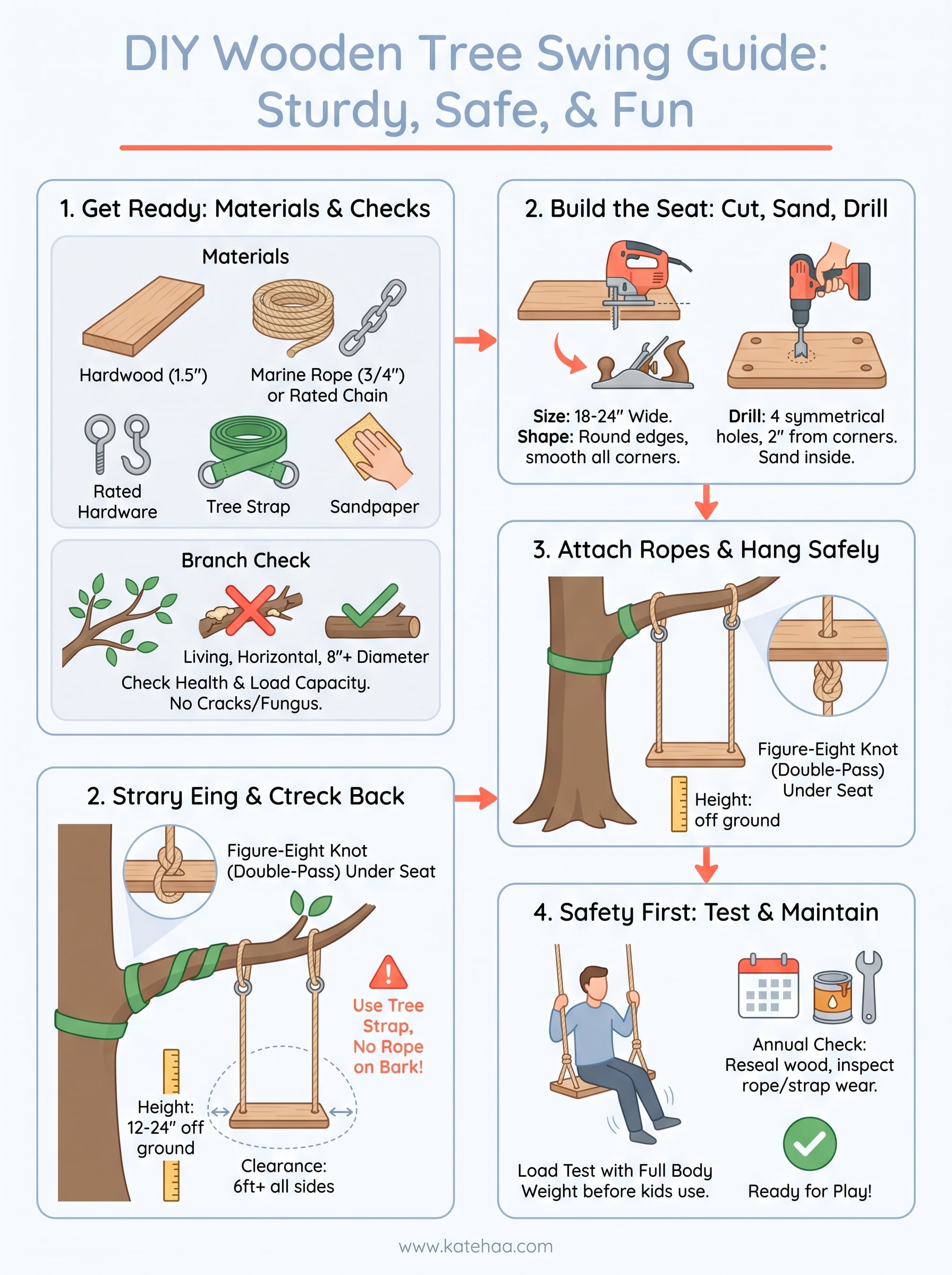
Choose a hardwood like oak, ash, or maple for the seat board since these species resist splitting under repeated stress better than softwoods like pine. You'll also need marine-grade rope or galvanized chain rated for at least 200 kg working load, plus stainless steel hardware so nothing rusts after a season of rain.
| Item | Recommended Spec |
|---|---|
| Seat board | Hardwood, 1.5" thick, 18-24" wide |
| Rope or chain | Nylon rope, 3/4" diameter, or galvanized chain |
| Eye bolts/hooks | Stainless steel, load-rated |
| Tree strap | Wide nylon strap, non-cinching |
| Sandpaper | 80, 120, 220 grit |
| Wood finish | Non-toxic outdoor sealant |
Tools to have on hand
Grab a jigsaw or circular saw for cutting the board, a drill with a spade bit matching your rope diameter, a hand plane or router for softening edges, and a level for checking your final hang. A tape measure and pencil round out the basics.
A swing is only as strong as its weakest connection point, so never substitute regular hardware store rope for rated load-bearing rope.
Check the branch before you buy anything
Walk out to your tree first. You want a living, healthy branch at least 8 inches in diameter, growing horizontally, with no visible cracks, fungus, or dead bark. If you're unsure, the USDA Forest Service offers guidance on assessing tree health, and a local arborist can confirm load capacity in five minutes for the price of a phone call. If your yard doesn't have a suitable branch, a freestanding swing set or a natural wooden disc swing built to hang from an A-frame stand solves the problem without waiting for a tree to mature.
Step 1. Cut and sand the seat board
Measure your board to 18-24 inches wide and cut it to a length that comfortably fits one or two riders, typically 20-24 inches deep. Use a jigsaw for curved edges or a circular saw for a straight rectangular seat, and always cut on the waste side of your pencil line so you have room to adjust if the cut wanders.
Shape the edges for comfort
Round off all four corners with a jigsaw or router to remove sharp points that catch clothing or scrape legs. A 1-inch radius works well for most seats. Then run a router or hand plane along every edge, top and bottom, to knock down the sharp 90-degree corners left by the saw.
A splinter-free seat isn't optional finishing work, it's the difference between a swing kids fight over and one they avoid.
Sand in stages, not all at once
Start with 80-grit to remove saw marks, move to 120-grit to smooth the surface, then finish with 220-grit for a touch-safe result. Skipping grits leaves swirl marks that show through finish later.
- 80-grit: remove rough saw marks
- 120-grit: smooth the surface
- 220-grit: final pass before finishing
Wipe the board clean with a damp cloth between grits so leftover dust doesn't clog your sandpaper or scratch the surface on the next pass.
Step 2. Drill the rope holes and shape the back
With your seat sanded smooth, mark the rope holes about 2 inches in from each corner on the same side, keeping them symmetrical so the seat hangs level. Drill straight down using a spade bit matched to your rope diameter, then flip the board and finish the hole from the other side to prevent blowout on the underside.
Drilling clean, load-bearing holes
Clamp the board to your workbench before drilling so it can't shift and crack the hole edges. Drill slowly, backing the bit out every inch or so to clear sawdust and keep the bit from overheating.
Uneven rope holes are the most common reason a homemade swing hangs crooked, so measure twice before the drill touches wood.
- Mark all four holes before drilling any of them
- Use a backing scrap under the board to prevent splintering
- Sand the inside of each hole with a rolled strip of sandpaper
Adding a back for extra support
Building a wooden tree swing with back means cutting a second board, roughly the same width as the seat and 12-16 inches tall, then attaching it with two L-brackets or a mortise joint angled slightly backward for comfort. This addition matters most for toddlers and older adults who need lumbar support during longer swinging sessions, and for the youngest riders a wooden baby swing with a backrest and safety bar does the same job without any cutting.
Step 3. Attach the ropes to the seat
Thread each rope end down through its hole from the top, then back up through the same hole to form a loop that sits flush against the underside of the board. This double-pass method spreads the load across more rope fiber than a single knot, which matters once kids start swinging hard.
Tying a knot that won't slip
Use a figure-eight knot on each end, since it's easier to inspect for wear than a simple overhand knot and won't tighten into a permanent jam over time. Pull each knot tight by hand, then test it by hanging your full body weight from the seat before you ever hang it in the tree.
A knot you can't visually inspect in ten seconds isn't a knot you should trust with a child's safety.
Double-check before moving outside
Run through this checklist before you head to the tree:
- Both ropes are cut to identical lengths
- Knots sit flush against the underside, not loose
- No fraying or nicks along either rope
- Seat hangs level when you lift it by both ropes
Once your seat passes every point, you're ready to move to the tree itself, where the branch and rigging matter just as much as the seat you just built.
Step 4. Hang the swing safely on the tree
Wrap your tree strap around the branch first, never the rope directly against bark, since bare rope saws through living wood over a few seasons and damages the tree. Loop the strap so it sits flat with no twists, then thread your rope or chain through the strap's rings rather than tying directly onto the branch itself.
Getting the height and clearance right
Position the seat so it hangs 12-24 inches off the ground when empty, giving riders room to push off without dragging their feet on every pass. Check that there's at least 6 feet of clearance on all sides, front to back and side to side, so nobody clips a trunk, fence, or play structure mid-swing.
A swing hung too close to the trunk turns every big push into a collision waiting to happen.
Testing before anyone climbs on
Before letting a child near it, load-test the finished swing yourself by sitting and bouncing your full weight several times, watching the strap and knots for any slipping.
- Confirm the branch shows no new cracking under load
- Recheck that the seat still hangs level
- Inspect the strap position after the first few uses, since bark settles
Once it passes, your wooden swing for tree setups is ready for regular use.
Your swing is ready for years of play
You now have a wooden tree swing built on a healthy branch, hung with rated hardware, and tested under your own weight before anyone else climbed on. That last part matters more than most builders admit. A swing that passes a real load test today keeps passing it years from now, as long as you check the strap and ropes each spring for wear.
Give the wood a fresh coat of sealant once a year and re-tighten any hardware that's loosened from seasonal expansion. Small maintenance now beats an emergency repair later, especially with kids swinging daily through summer.
If building isn't how you want to spend your weekend, or you'd rather skip straight to a design tested for years of rough play, take a look at our classic wooden tree swing with adjustable rope, built to the same standards and ready to hang the day it arrives.