
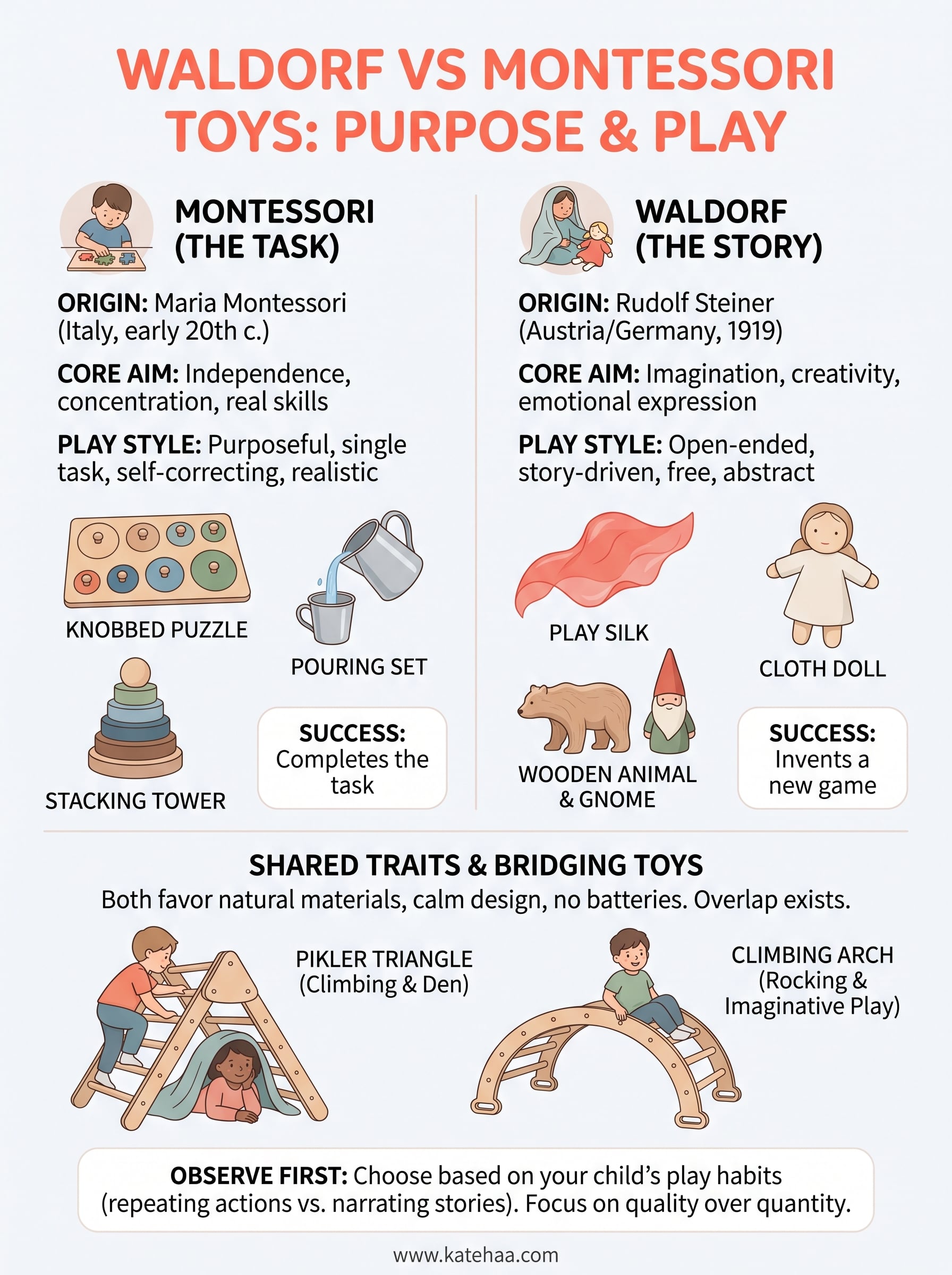
Waldorf vs Montessori toys comes down to purpose. A Montessori toy teaches one clear skill through a real, self-correcting task, such as a knobbed puzzle, a pouring jug or a stacking set. A Waldorf toy is simple, natural and open-ended, such as a play silk, a cloth doll or a wooden animal, and it leaves the story to your child.
Both styles grew out of early 20th century education and share a taste for natural materials, calm design and play without batteries. That overlap is why shop descriptions blur them together. The two still ask different things of a child. One invites focus and mastery. The other invites imagination and storytelling.
This article shows why the difference matters before you spend money, then compares the two styles on materials, play and philosophy. After that, you get a method for choosing, examples of toys that work in both styles, and the labeling and safety mistakes to avoid. We design wooden Montessori-inspired climbing toys and furniture at KateHaa, and we see every day how families mix both approaches.
Why the difference between the two toy styles matters
The difference matters because each style rewards a different kind of play, and a toy that does not match your child's habits ends up on a shelf. The two toy styles also differ in price, in how many pieces you need and in how a child uses them.
Two philosophies, two goals
Montessori toys come from Maria Montessori, an Italian physician who built her materials around how children learn practical skills. Her classroom materials isolate one idea, such as size, weight or shape. They often contain a built-in "control of error," so a child sees a mistake without an adult pointing it out.
Waldorf toys come from Rudolf Steiner, an Austrian philosopher whose first school opened in Stuttgart in 1919. His approach treats early childhood as a time for imagination, rhythm and sensory experience. A Waldorf toy is deliberately unfinished. A doll with a barely sketched face can be happy, sad or sleepy, depending on the story.
A Montessori toy asks the child to do something. A Waldorf toy waits for the child to decide.
What a wrong match costs you
A mismatch rarely causes harm. It causes waste. These are the patterns we see most often:
- A child who loves sorting and fitting gets a bag of silks and felt gnomes, and loses interest within a week.
- An imaginative child gets a drawer of single-task puzzles, completes each one once and moves on.
- Gift givers buy "Montessori" or "Waldorf" items by label alone, and the room fills with toys no one chose.
- You pay premium prices for natural-material toys that do not match how your child plays.
Knowing the difference lets you buy fewer toys and use them longer. Both philosophies favor a small, well-chosen collection over a toy box that overflows.
Waldorf vs Montessori toys side by side
The two toy styles differ most in play style and in how real the toy is. Materials overlap more than most guides admit, because both favor natural, tactile things. The table sets the main points next to each other.
Comparison at a glance
| Aspect | Montessori toys | Waldorf toys |
|---|---|---|
| Origin | Maria Montessori, Italy | Rudolf Steiner, Austria and Germany |
| Core aim | Independence, concentration, real skills | Imagination, creativity, emotional expression |
| Play style | Purposeful, one task at a time | Open-ended, story-driven, free |
| Realism | Realistic, true to life | Abstract, simple, suggestive |
| Materials | Wood, plus metal, glass or ceramic for real-life items | Wood, wool, cotton, silk, beeswax |
| Colors | Often clear, bright colors that isolate one quality | Soft, muted, nature-inspired tones |
| Typical toys | Puzzles, shape sorters, threading, pouring sets, child-sized tools | Play silks, cloth and peg dolls, wooden animals, blocks, gnomes |
| Success looks like | The child completes or masters the task | The child invents a new game |
How the play differs in practice
Give a child a set of wooden blocks and the styles show their character. A Montessori approach might offer graded blocks that stack in one correct order. The child learns size and balance and sees at once whether the tower works. A Waldorf approach offers plain, unpainted blocks and no instructions. They become a castle, a farm and a bed for the doll within ten minutes.
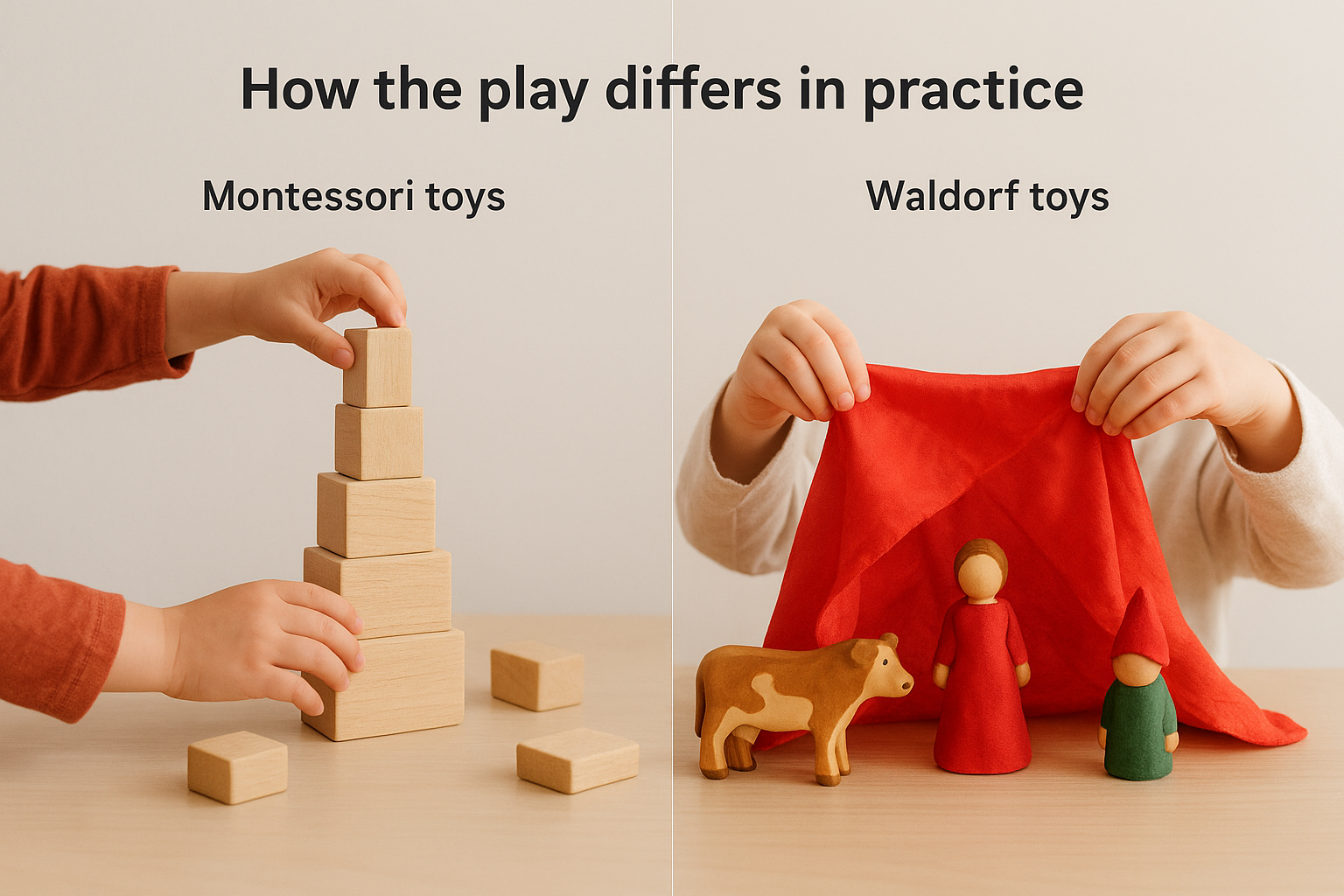
The same split appears in pretend play. Montessori toys tend toward real-life imitation, such as a small working broom, a real glass pitcher or a child-sized watering can. Waldorf toys lean toward fantasy. A silk cloth can be a river, a cape or a roof. Neither approach is more educational. They train different muscles. Montessori builds focus and practical skill, and Waldorf builds narrative thinking and flexibility.
Materials overlap, but purpose does not: one style teaches a task, the other hands over a blank page.
How to choose the right toys for your child
Choose by watching how your child already plays, then match the toy style to that behavior. Age and your home matter too, but observation beats any label.
Observe before you buy
Spend three or four days watching without steering. Then check these signs:
- Does your child repeat one action, like filling and emptying a container, until it is done? That points to Montessori.
- Does your child narrate, give voices to objects or turn a cushion into a boat? That points to Waldorf.
- Does your child get frustrated when a toy has no "right" result? Choose Montessori-style toys with clear feedback.
- Does your child ignore toys with one fixed use? Choose open-ended pieces.
- Does your child need to move a lot? Add active toys such as climbers, which suit either style.
Most children show both tendencies, depending on the hour. That is normal. A pattern across several days tells you where to put most of your budget.
Match the style to age and space
Under one year, the two styles look alike: soft grasping toys, wooden rattles, wool balls and a few cloth dolls. The split grows from around age two. A toddler can start with practical-life sets and simple puzzles, or with silks, animals and blocks, and both choices work.
For a small room, count storage as part of the decision. Montessori toys work best on a low, open shelf where your child can see each item and return it. Waldorf toys can live in baskets, since the pieces are interchangeable and the child builds with whatever comes out. Either way, rotate a handful of toys and store the rest. You will get longer, calmer play from eight good items than from forty.
Let your child's play habits pick the style, and let the size of your room set the number of toys.
Toys that serve both styles
Some toys fit both philosophies, and they are often the best long-term buys. A good bridge toy has a real physical challenge or purpose, but no fixed script. Climbing and movement toys are the clearest example.
Open-ended pieces with a real purpose
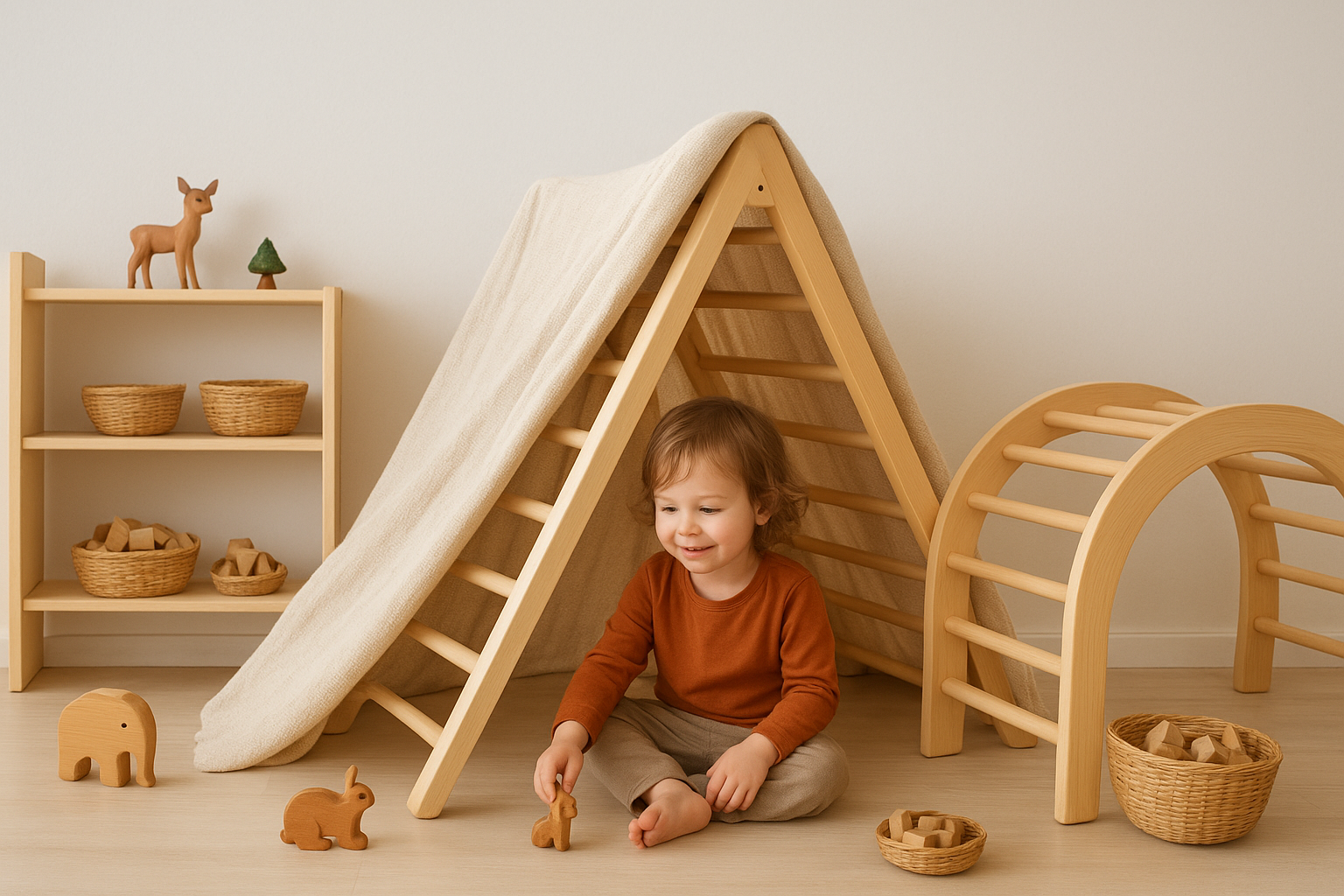
A Pikler triangle builds balance, strength and risk assessment, which suits the Montessori focus on independent mastery. Drape a blanket over it and it becomes a tent, which suits Waldorf-style storytelling. A climbing arch works the same way. It rocks, climbs and slides, and a child can also turn it into a shop counter or a pirate ship. The table lists our pieces and how each fits both styles.
| Item | Price | Montessori side | Waldorf side |
|---|---|---|---|
| Pikler triangle | 172 EUR | Independent climbing, motor skills | Tent, den or hideout with a blanket |
| Climbing arch | 149 EUR | Balance, coordination, strength | Boat, shop counter, pirate ship |
| Montessori shelf, five sections | 159 EUR | Order, visible choices, self-service | Display for baskets and natural pieces |
| Wooden swing | 84 EUR | Core strength, spatial awareness | Flying, sailing, adventure games |
The triangle and the arch are rated for 24+ months, with a maximum combined user weight of 50 kg and one user at a time. The wooden swing is made for children aged 3 and up.
A worked starter example
Take a two-year-old in a small playroom with a budget of about 500 EUR. A Pikler triangle (172 EUR), a climbing arch (149 EUR) and a five-section shelf (159 EUR) come to 480 EUR. The triangle and arch cover movement. The shelf teaches your child to choose and put things back. You then add silks, a few wooden animals and a basket of blocks from any source for imaginative play. The big pieces last for years and serve each stage, which is why one plan can cover both philosophies.
Spend on the large, durable pieces that adapt, and keep the small imaginative extras cheap.
Mistakes to avoid when buying either style
The most common mistakes are trusting a label too much and skipping safety checks. Both are easy to fix with a few questions before you pay.
Do not trust the label alone
Nothing regulates which toys may be sold as "Montessori," so the word can appear on a plastic toy with flashing lights. "Waldorf-style" is just as loose. Judge the toy by what it does:
- Does it have one clear purpose, with real feedback? Then it fits Montessori.
- Does it leave the story open and use natural, simple materials? Then it fits Waldorf.
- Is it loud, battery-powered or crowded with features? It fits neither, whatever the box says.
Check safety and age grading
In Europe, look for conformity with the EN71 toy safety standard and for clear age grading. Small parts, loose felt pieces and long cords matter most for children under three. Check finishes too. Water-based, child-safe varnish and responsibly sourced wood are good signs. Our KateHaa products meet EN71 and ASTM standards, and any seller should tell you which standard applies. Also confirm weight limits on climbing items, and always supervise play on climbers and swings.
A toy that is calm, simple and safe beats a toy that only carries the right word on the box.
Pick the play, not the label
Montessori toys build focus and real skills through one clear task, and Waldorf toys build imagination through open-ended, natural materials. They are not rivals. Observe how your child plays, buy fewer and better pieces, and lean on toys such as climbers that give both challenge and room for stories.
If you want large wooden pieces that grow with your child, browse KateHaa's wooden climbing toys and Montessori furniture. Start with the one piece your child will use every day, and build from there.