
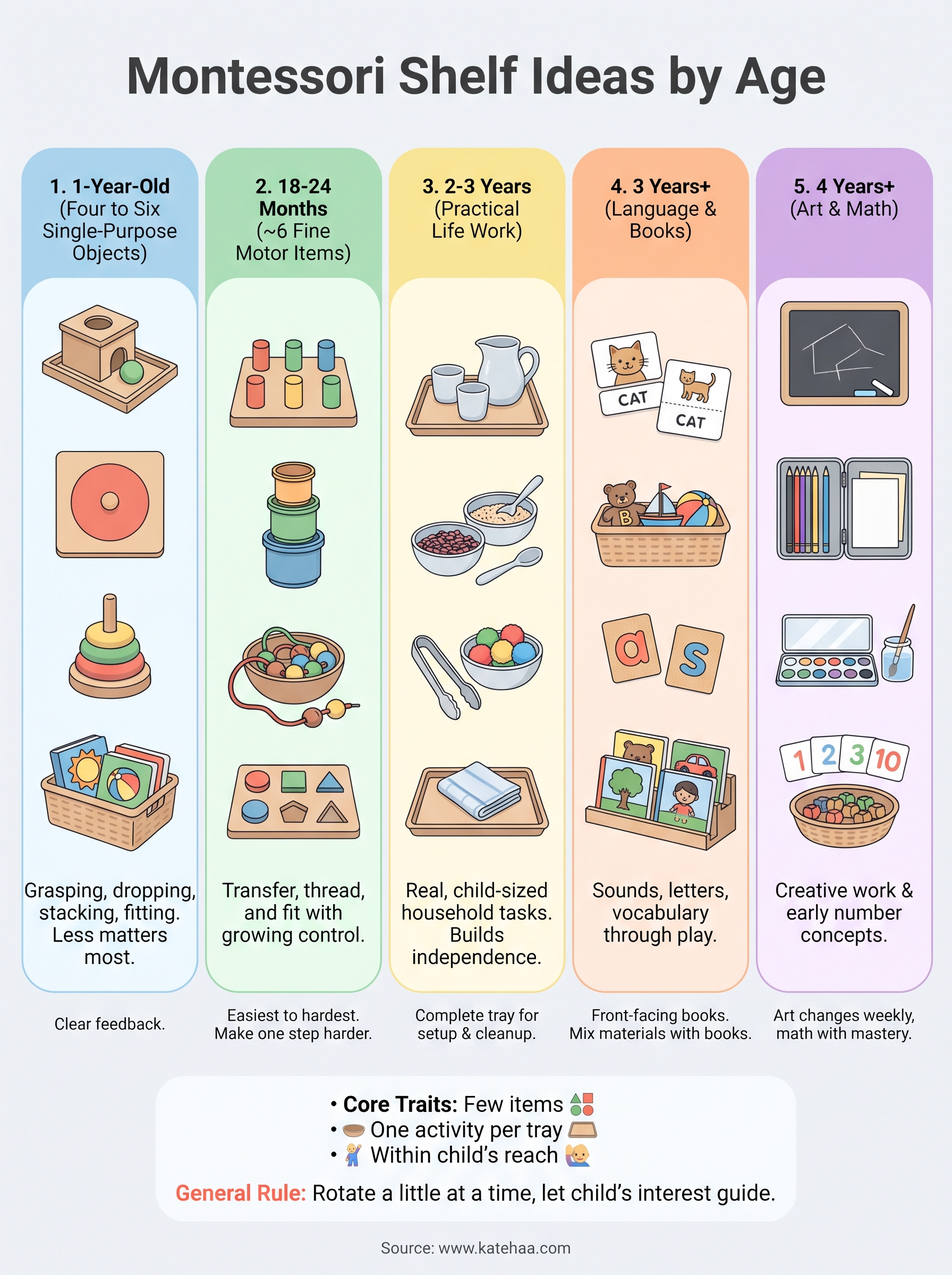
The best Montessori shelf ideas share three traits: few items, one activity per tray or basket, and everything within the child's reach. For a 1-year-old, that means four to six simple objects on a low shelf. For ages 2 to 3, it means practical life work like pouring and spooning. From age 3 up, the shelf shifts to language, art, and early math materials.
Most parents hit the same problem. The shelf fills up, the child dumps every basket on the floor, and nobody knows what to swap out or when. Advice is scattered across photo boards and blog posts, and few of them explain why an item sits where it does.
This guide gives you five shelf setups in age order. Each one covers what to put on the shelf, how to arrange it, and when to rotate it. At KateHaa we design and build low wooden Montessori furniture, so shelf height, spacing, and sturdiness are things we think about every day.
1. A first shelf for a 1-year-old
A shelf for a 1-year-old holds four to six single-purpose objects that train grasping, dropping, stacking, and fitting. It is the simplest setup in this guide, and the one where less matters most.
What goes on the shelf
Pick items that give clear feedback when the child handles them. Good starters:
- An object permanence box, where a ball drops through a hole and rolls out on a tray
- A one-piece puzzle with a large knob
- A wooden ring stacker with a single post
- A basket with two textured balls
- A small basket of three or four board books, covers facing out
Check every piece for size. Anything that fits through a toilet paper tube is a choking risk for a child under 3.
How to arrange it
Place one activity per tray or basket on the bottom and middle levels, where a crawling or cruising child can reach them. Leave gaps between items so each one reads as a separate choice. A three-section shelf keeps the display small enough to take in at once. KateHaa's Montessori shelf with three sections costs 159 EUR.
For a baby under 12 months, cut the shelf to three or four items on the lowest level. A grasping ring, a ball, and a soft cloth are plenty.
When and how to rotate
Swap one or two items every one to two weeks, never the whole shelf. Keep whatever the child returns to daily. Ignoring an item for several days, or only throwing it, is your cue to remove it. Store removed items out of sight and bring them back a month later.
A 1-year-old's shelf works when every item has one obvious thing to do.
2. A fine motor shelf for 18 to 24 months
Between 18 and 24 months, children want to transfer, thread, and fit objects with growing control. This shelf adds small challenges without crowding the child with choices.

What goes on the shelf
Aim for six items:
- A peg board with three or four large pegs
- Stacking cups or nesting boxes
- A single-cylinder block with a knob
- A basket of large wooden beads with a thick lacing cord
- A simple shape sorter with two or three shapes
- A bowl of pom-poms with a second bowl for transferring by hand
Keep beads and pegs well above the small parts size.
How to arrange it
Order the items from easiest to hardest, left to right. Put the shape sorter and cups on the left and lacing on the right. Use shallow trays with a low rim so the child can see the whole activity. One tray, one task, with everything needed already on it.
When and how to rotate
Rotate weekly, or sooner when the child finishes an activity quickly and repeats it without effort. Instead of replacing a mastered item, make it one step harder. Go from one peg to three, or from two shapes to four. This keeps the shelf familiar while the work grows.
Raise the difficulty of one familiar item before you bring in something new.
3. A practical life shelf for ages 2 to 3
Two-year-olds want to do what adults do, so this shelf holds real, child-sized household tasks. Practical life work builds concentration, coordination, and independence. For many families, it is the most-used shelf of the whole childhood.
What goes on the shelf
Start with simple tasks and add one at a time:
- Dry pouring: a small pitcher of rice or lentils and two cups
- Spooning beans between bowls
- Tong or tweezer transfers of large pom-poms
- A sponge and two bowls for water transfer
- A cloth napkin to fold
- Two or three flower stems with a small vase
How to arrange it
Build each task as a complete tray: the materials, a small cloth for spills, and a sponge to wipe up. The child then handles the whole cycle, from setup to cleanup, without asking for help. Eight trays is the upper limit. Place heavy items like pitchers on the lowest level so they cannot fall on the child.
When and how to rotate
Rotate every two weeks, and tie some trays to the season, like autumn leaves or spring flowers. Always move from dry pouring to water pouring only after dry pouring is clean and confident. Offer the harder version in the same pitcher so the task stays familiar.
Give each practical life tray everything needed to finish and clean up the job.
4. A language and book shelf for ages 3 and up
By age 3, many children are ready for sounds, letters, and vocabulary. This shelf mixes materials with books so language work happens through play rather than drills.

What goes on the shelf
Use materials in small doses:
- Object-to-picture matching cards
- Three-part cards (picture, label, and a card with both)
- A basket of small objects that share a starting sound
- Two or three sandpaper letters, added gradually
- Four to six picture books with covers facing out
For the book display, KateHaa's Kids Bookshelf (175 EUR) has four display shelves and two extra storage shelves. Its angled shelves keep books from slipping out.
How to arrange it
Keep the language materials on the middle level and the books at the child's eye height. Front-facing books invite a child to choose by cover, which a stacked spine row does not. Put the sound game and cards in separate trays so they never mix.
When and how to rotate
Swap the books every week and add only two or three sandpaper letters at a time. Introduce a new letter only when the child can name the earlier ones. Keep one old favorite book on the shelf at all times for comfort.
Introduce language materials a few at a time and let books rotate faster than letters.
5. An art and math shelf for ages 4 and up
For 4-year-olds, the shelf should offer creative work and early number concepts in equal measure. It supports longer focus and gives the child a sense of real accomplishment.
What goes on the shelf
Combine art and early math:
- A small slate chalkboard for drawing straight and curved lines
- Stencils or metal insets with colored pencils and paper
- Watercolors with a brush and a small jar
- Number cards from 1 to 10 with a basket of counting objects
- A sorting tray with objects to group by size or color
How to arrange it
Put art supplies together on one level, with paper stacked and tools ready. Place math materials on another so the child can tell the two kinds of work apart. The most-used tray should sit at the child's elbow height. Keep sharp or messy items on a tray with a lip to hold them.
When and how to rotate
Change the art tray every week with a new theme, like leaves, animals, or patterns. Update the math tray only when the child counts to 10 without help. After that, extend to larger numbers or add a simple matching game rather than replacing the old one.
A 4-year-old's shelf stays interesting when art changes weekly and math changes with mastery.
Start small and watch your child
A good Montessori shelf is small, tidy, and built around what your child can do right now. Four to six items suit a 1-year-old, and about eight trays suit an older preschooler. In every case, you rotate a little at a time and let your child's interest guide each swap.
If you are choosing furniture to match these setups, a low, sturdy, open shelf is the right base. You can see KateHaa's range of wooden Montessori shelves and children's furniture, all made in Latvia with free shipping across Europe.