

If your living room looks like a toy bin exploded, you're not alone. Most storage solutions fight against how kids actually play, deep boxes where toys disappear, closed cabinets kids can't open, shelves too tall to reach. Toy storage montessori style flips that around: everything low, visible, and sized for small hands, so your child can choose a toy and put it back without asking for help.
Good montessori toy storage isn't about buying more bins. It's about open shelving at child height, limited choices displayed like a small shop, and furniture that lets kids build independence instead of relying on you to dig through a chest. Get the setup right and cleanup stops being a daily battle.
We design wooden, Scandinavian-style furniture for exactly this kind of setup, so this list leans on what actually works in real playrooms, not just Pinterest boards. Below are six montessori playroom shelf and storage ideas you can adapt to any space, whether you have a dedicated playroom or just a corner of the living room.
1. Low, open Montessori shelves
Low, open shelving is the foundation of any montessori playroom shelf setup, and it's the single change that fixes the most cleanup problems. Instead of stacking toys behind cabinet doors, you place them on shelves no taller than your child's chest, so every item is visible and reachable without climbing or asking for help.

How it works
Open shelves work because they turn toy selection into a visual menu. Your child scans a few options, picks one, plays, and returns it to the same spot, which is the whole point of Montessori toy storage: matching storage height and layout to a child's actual size and reach. Most parents use a shelf with two to three tiers and stick to five or six toys displayed at once, rotating the rest out of sight so the shelf never looks cluttered. Wooden shelves with rounded edges and a stable, weighted base hold up best once toddlers start using them as a step stool, which they will.
A shelf a child can reach is worth more than a bin they can't open.
Who it's for
This setup fits families with toddlers and preschoolers, roughly ages 1 to 6, who are just learning to make choices and follow a routine. It also works well in shared playrooms where siblings of different ages need separate, clearly defined zones. If your child is older and already independent with cleanup, low shelves matter less, though a shelf still helps keep a room looking calm.
Price range
Open wooden shelving units typically run from around €90 for a simple single unit to €250 or more for larger, furniture-grade pieces built to match a full room set. Our own Montessori shelves are built from solid wood with rounded edges and a low center of gravity, priced in that same range depending on size, so you can start with one unit and expand as your child grows into needing more display space.
2. Rotating toy baskets and trays
Open shelves solve visibility, but too many toys on display still overwhelms a small child. Rotating toy baskets and trays solve that second problem by limiting choice to a handful of activities at a time, then swapping the selection every week or two so the shelf always feels fresh without buying anything new.
How it works
Group toys by activity, one basket for building blocks, one tray for a puzzle and matching cards, one for pretend play pieces, and place only three or four of these on the shelf at once. Keep the rest in a closet bin labeled by category, then rotate them in on a schedule that matches your child's attention span. This is one of the simplest montessori toy storage ideas because it costs almost nothing and instantly reduces clutter and decision fatigue.
Fewer toys in view means longer, deeper play with each one.
Who it's for
Rotation suits toddlers and preschoolers who get bored fast or dump everything at once. Parents managing small playrooms or shared bedrooms also lean on it heavily, since it stretches limited shelf space across a much larger toy collection.
Price range
Woven or wooden trays run roughly €10 to €30 each, so a full rotating system usually costs €40 to €100 for six to eight trays and baskets combined.
3. Labeled storage bins for easy cleanup
Bins get a bad reputation in Montessori circles because deep, unlabeled toy boxes hide everything and turn cleanup into a dumping ground. Labeled storage bins avoid that trap by staying shallow, clear, and marked with a picture or word so your child knows exactly where each toy belongs, even before they can read.
How it works
Pick low, wide bins over tall ones, since a shallow container lets your child see the contents without digging. Attach a simple label, a photo of the toy, a drawn icon, or a printed word for older kids, and keep one bin per category: cars, animals, art supplies. This single habit is one of the most practical montessori toy storage ideas because it teaches sorting and categorizing every time your child puts something away.
A labeled bin turns cleanup into a matching game, not a chore.
Who it's for
Bins work best for toddlers through early elementary kids, roughly 2 to 8 years old, who are learning categories and enjoy the small satisfaction of matching an object to its picture. They're also ideal for toys with many small pieces, like blocks or figurines, that don't display well on open shelves.
Price range
Simple fabric or plastic bins cost €5 to €15 each, while sturdier wooden or canvas bins with reinforced labels run €15 to €30, so a full set for a playroom typically lands between €50 and €120.
4. Child-height book displays
Books get buried in toy bins more often than not, which means kids stop reaching for them. Child-height book displays put picture books face-out instead of spine-out, at a height a toddler can grab without help, turning reading into another independent choice on the shelf.
How it works
Forward-facing shelves work because young children recognize a cover image long before they recognize a title printed along a spine. Mount a shallow ledge or slanted shelf low on the wall, rotate five or six books at a time, and swap them out on the same schedule as the toy trays above. This approach is a favorite among montessori toy storage ideas because it treats books as another category of accessible play, not a separate rule with its own furniture.
A book cover a child can see is a book a child will pick up.
Who it's for
This setup suits infants through early readers, roughly 6 months to 6 years old, since face-out display works well long before a child can read titles for themselves. Families building an early reading habit lean on it most, especially tucked into a bedroom nook or set beside a reading chair.
Price range
Wall-mounted wooden ledges run about €15 to €40 each, while a small standing wooden bookshelf with a display lip typically costs €50 to €120 depending on size and finish.
5. Multi-purpose furniture like activity cubes and playhouses
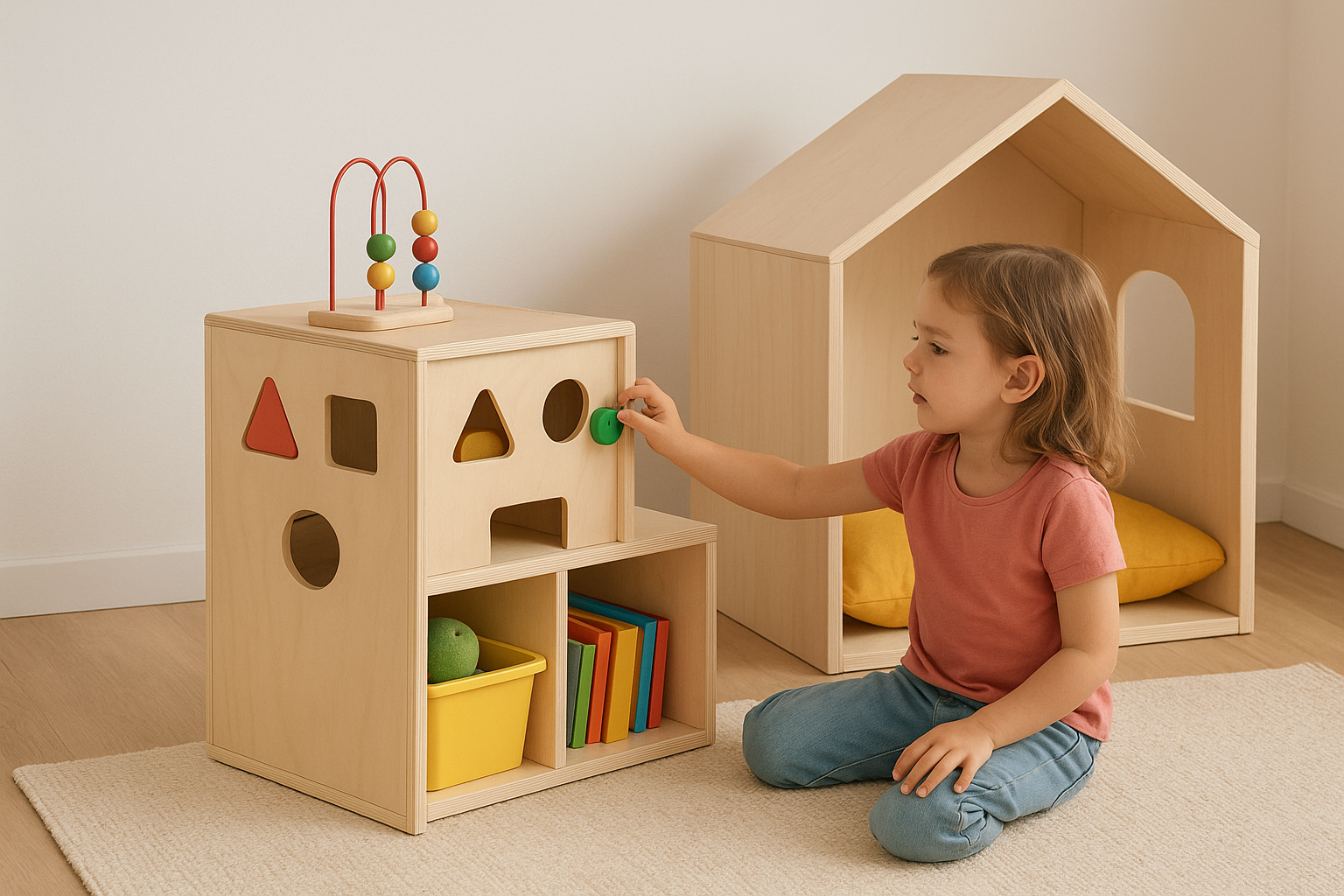
Some of the best montessori toy storage ideas don't look like storage at all. Activity cubes and small indoor playhouses double as furniture your child climbs on, sits inside, or uses as a reading nook, while the cubbies and shelves built into the frame quietly hold toys, books, and puzzles.
How it works
A typical activity cube stacks open cubbies at child height, so bins slide in and out the same way they would on a standard shelf, except the whole unit also works as a step, a seat, or a base for pretend play. Our own Build and Play activity cubes and playhouses convert between a few configurations, so the same piece stores toys one week and becomes a fort the next. That flexibility matters more than an extra shelf, because a piece your child actually plays on gets used daily instead of ignored in a corner.
Furniture your child plays on gets used. Furniture that just sits there doesn't.
Who it's for
This fits families with limited square footage who need every piece to earn its space, and kids roughly 2 to 8 who still treat furniture as a prop for imaginative play.
Price range
Wooden activity cubes and small playhouse units generally run €150 to €400, depending on size and the number of configurations included.
6. Creative small-space storage solutions
Not every family has a dedicated playroom, and small-space storage solutions matter just as much as full shelving units when your play area is a corner, a hallway nook, or a shared bedroom. The goal stays the same: keep toys visible and reachable, just scaled down to fit whatever square footage you actually have.
How it works
Wall-mounted ledges, narrow rolling carts, and under-bed bins let you apply Montessori storage principles without dedicating a whole room to it. A few ideas that work well in tight spaces:
- A slim rolling cart tucked beside a couch, pulled out during play and pushed away after
- A corner shelf mounted at child height in a shared bedroom
- Stackable bins under a low bed frame, labeled the same way as regular shelf bins
- A fold-flat activity cube that collapses when guests visit
Our custom-sized Montessori furniture options exist for exactly this problem, since a standard shelf width doesn't always fit an oddly shaped nook.
A tiny apartment can still run a full Montessori toy storage system, it just needs smaller furniture.
Who it's for
Apartment dwellers, families sharing bedrooms, and anyone renting a space where a full playroom setup isn't practical will get the most value here.
Price range
Compact carts and corner shelves generally cost €40 to €120, while custom-sized pieces built to fit a specific nook run closer to €100 to €250.
Finding the right storage mix for your family
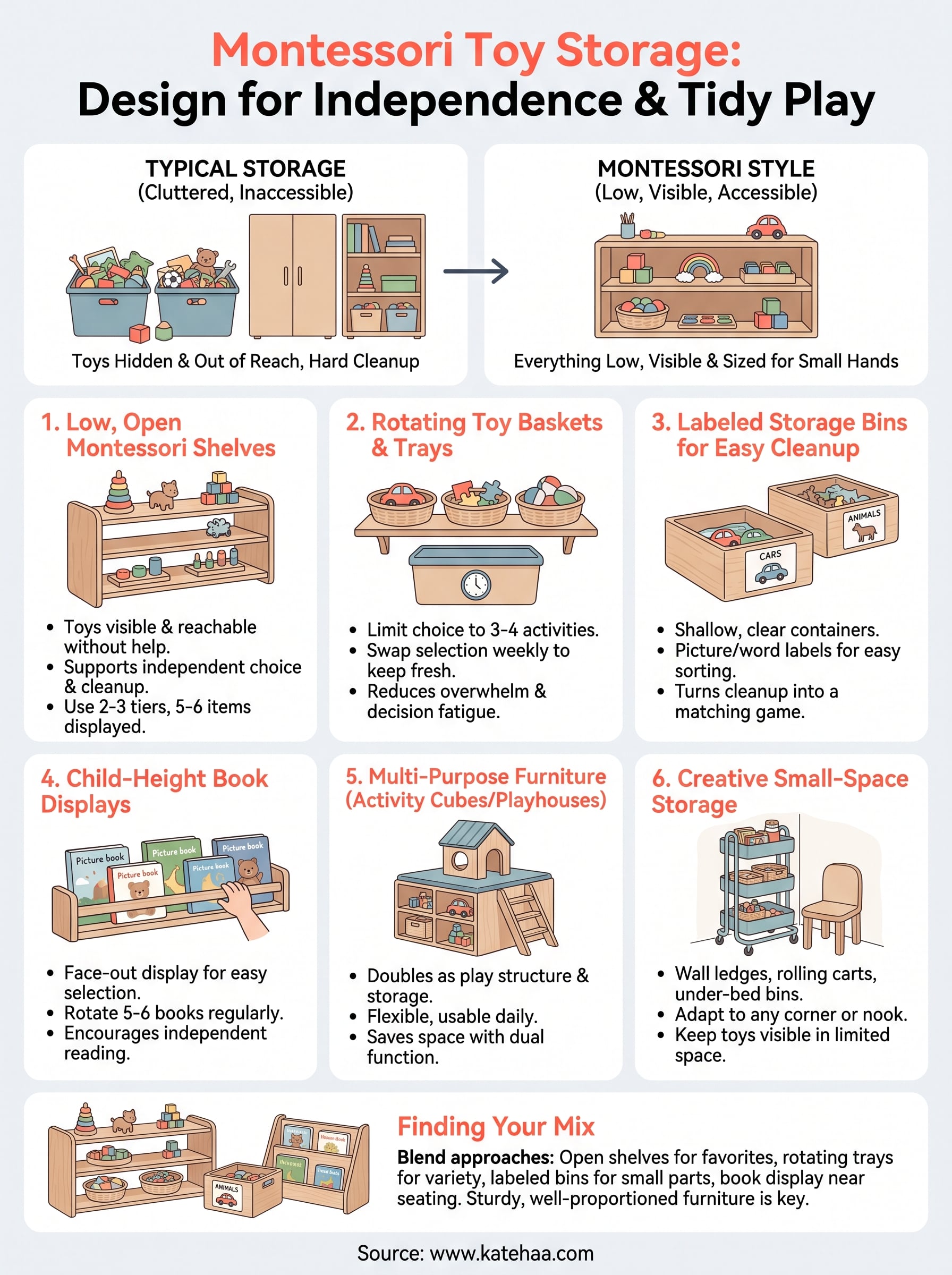
No single idea on this list works alone. Toy storage montessori style usually blends two or three of these approaches: open shelves for the everyday favorites, rotating trays to keep things fresh, labeled bins for the small stuff, and a book display within reach of a reading chair. Start with the shelf, since it's the foundation everything else builds on, then add pieces as you notice where cleanup still breaks down.
Once you know which combination fits your space, the furniture matters more than any organizing trick. Sturdy, well-proportioned pieces hold up to years of daily use and actually get chosen by kids instead of ignored. If you're ready to set up a shelf, activity cube, or custom-fit nook that your child will use on their own, browse our full range of Montessori furniture and build a playroom that stays tidy without you having to nag.