

At six months, your baby is sitting up, reaching, grabbing, and suddenly a lot more interested in the world around her. The toys that worked for a newborn, rattles she couldn't yet hold, mobiles she could only stare at, aren't cutting it anymore. If you're searching for montessori 6 months toys, you're probably noticing this shift and wondering what actually supports it, rather than just making noise and lighting up.
The short answer: look for open-ended, natural materials that respond to your baby's own movement and curiosity, not battery-powered gadgets that do the entertaining for her. Good montessori toys 6-12 months encourage grasping, pulling to stand, object exploration, and cause-and-effect learning at whatever pace your baby is ready for, whether that's 6, 7, 8, or 9 months.
We've spent years designing wooden play pieces around exactly this stage of development, so we know what holds up to drool, drops, and daily use while still doing its job. Below are seven toys we'd recommend without hesitation, covering everything from first grasping toys to early climbing pieces for babies edging toward their first steps.
1. Pikler triangle with ramp
What it is

A Pikler triangle is a wooden A-frame climbing structure named after the Hungarian pediatrician Emmi Pikler, who studied how babies move when adults get out of their way. At six months, your baby won't climb it yet, but she'll pull herself up against the rungs, cruise along the base, and use it as a sturdy prop for practicing sitting and kneeling. Add a ramp attachment and you get a gentle slope she can crawl up and slide down once she's mobile, turning one piece of furniture into months of graduated challenges. Our climbing triangle with ramp is built from solid birch specifically so it can take this kind of daily pulling and leaning without wobbling.
Developmental benefits
Unlike a baby walker or bouncer, a Pikler triangle asks nothing of your baby except to move at her own pace, which is the entire point of gross motor development done Montessori-style. Pulling up on the rungs strengthens the legs, back, and grip she'll need for standing and eventually walking. The ramp adds a second skill layer: crawling up an inclined surface builds core strength and spatial judgment in a way flat floor crawling doesn't.
A Pikler triangle doesn't teach your baby to move. It gets out of the way so she can teach herself.
Best age to introduce
Most babies get real use out of a Pikler triangle starting around 7 to 8 months, once they're sitting independently and starting to pull to stand on furniture anyway. If you're shopping for montessori 6 month old toys, it's fine to bring one in early and let her simply touch, gum, and lean on the base while she works toward pulling up. By 9 to 12 months, she'll likely be cruising the rungs and attempting the ramp, so this single piece easily spans the full range parents search for under montessori toys 6 12 months.
What to look for when buying
Not every triangle on the market is built to the same standard. Before buying, check for:
- Rounded rungs spaced closely enough that small hands and feet grip securely
- A wide, stable base that won't tip when a baby pulls on the top rung
- Non-toxic, water-based finishes rather than varnish or paint that could chip
- A weight rating clearly listed, ideally certified to EU or ASTM safety standards
- A ramp that locks in place rather than sliding loose during play
2. Sensory grasping balls
What it is
Sensory grasping balls are small, lightweight balls made from wood, silicone, or a mix of textured materials, sized to fit comfortably in a baby's palm. Unlike a plastic rattle, they don't need batteries or buttons to hold interest. Each surface, ridged, dotted, smooth, or woven, gives your baby something different to feel and explore with her fingers and mouth, which is exactly how babies at this age gather information about the world.
Developmental benefits
Grasping and releasing a ball repeatedly builds the fine motor control your baby needs before she can feed herself with a spoon or stack blocks later on. The varied textures also support early sensory processing, giving her tactile input that's richer than a single smooth plastic toy can offer. Because the balls roll, she gets an early, low-stakes lesson in cause and effect: push it, and it moves away, then she has to crawl or reach to get it back.
The best baby toys don't need to do anything on their own. They just need to respond honestly to what your baby does to them.
Best age to introduce
This is genuinely one of the earliest montessori 6 month old toys you can hand over, since it only requires a functioning palmar grasp, which most babies have by 5 to 6 months. By 8 or 9 months, expect her to switch from mouthing the ball to actively rolling and chasing it, a natural precursor to crawling games.
What to look for when buying
- Untreated or food-grade wood, since these balls go straight in the mouth
- Varied textures on different balls rather than one repeated pattern
- A size too large to swallow, generally over 4.4 cm in diameter
- No small attached parts like beads or strings that could detach
3. Object permanence box
What it is
An object permanence box is a simple wooden box with a hole in the top and a small drawer or catch tray underneath. Your baby drops a ball through the hole, watches it disappear, and then discovers it again in the tray below. It looks almost too plain to matter, but Maria Montessori considered this one of the most important early cognitive toys, and it remains a staple across montessori 7 month old toys lists for good reason.
Developmental benefits
Before babies grasp object permanence, they genuinely believe that whatever leaves their sight has ceased to exist. This box gives her repeated, hands-on proof otherwise: the ball vanishes, then reappears in a predictable place. That single realization underpins later skills like searching for a dropped toy, tolerating separation from a parent, and understanding that people and things persist even when unseen.
A toy that disappears and reappears teaches your baby the world is more permanent than it looks.
Beyond the cognitive leap, dropping the ball through a precise hole also sharpens hand-eye coordination and the pincer-adjacent grip babies refine around this age.
Best age to introduce
Most babies show interest between 8 and 10 months, once they can sit unsupported and manipulate a small object with intent. Searching for montessori 9 month toys specifically? This is often the exact age where the box clicks, and babies will repeat the drop-and-retrieve cycle dozens of times in one sitting.
What to look for when buying
- A ball sized for one hand, not so small it's a choking risk
- A smooth, splinter-free drawer that slides without sticking
- Solid wood construction heavy enough not to slide across the floor during play
4. Wooden ring stacker
What it is
A wooden ring stacker is a vertical dowel set into a stable base, paired with a series of rings in graduated sizes or colors that your baby threads on and pulls off. It looks like a simple stacking toy, but the Montessori version skips the cartoon characters and bright plastic in favor of plain wood or muted natural dyes, so the shapes and sizes do the teaching instead of the colors. Some versions swap the straight dowel for a curved or spiral post, which slows the rings down as they fall and gives your baby more time to watch what's happening.
Developmental benefits
Threading a ring onto a post demands real hand-eye coordination, since your baby has to line up a hole with a fixed point while holding the ring steady with one hand. Removing the rings again, often the first skill babies master, builds the same fine motor control that grasping balls started developing a few months earlier. If the rings vary in size, she also gets an early, wordless lesson in relative size and sequencing, which lays groundwork for the sorting and matching activities that come later in toddlerhood.
A ring stacker rewards patience over speed, which is exactly the pace a six-month-old needs to learn at.
Best age to introduce
Babies typically start by simply removing rings around 6 to 7 months, well before they can thread one back on. Full stacking usually clicks between 9 and 12 months, so parents searching montessori toys 6 month old through toddlerhood get genuine long-term use from one purchase.
What to look for when buying
- A weighted, wide base that won't tip while your baby yanks rings off
- Rings large enough to avoid any choking risk
- Smooth-sanded edges with no paint that could chip or peel
- A post short enough that a full stack doesn't topple easily
5. Treasure basket
What it is
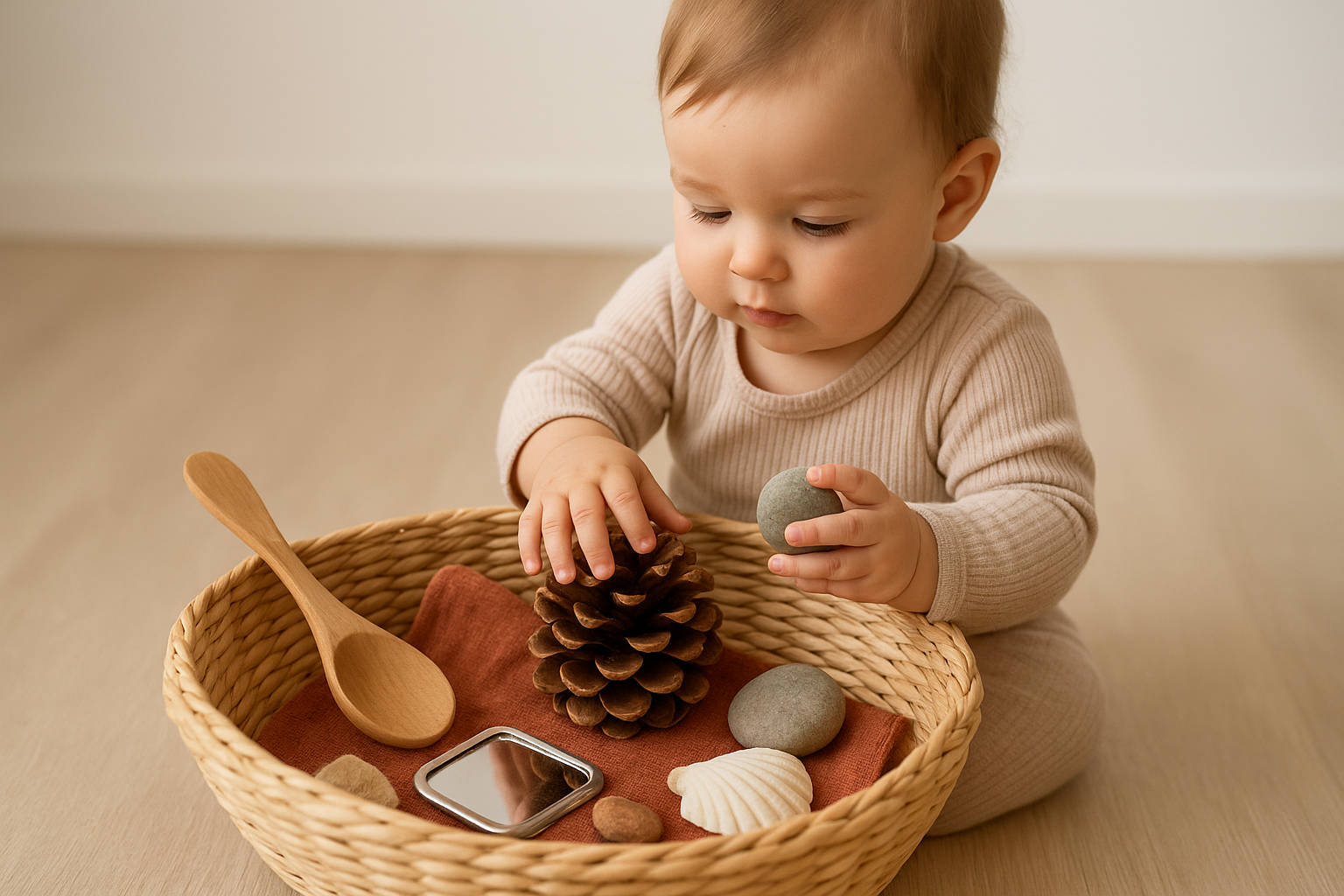
A treasure basket, sometimes called a Montessori discovery basket, is a low, open container filled with everyday objects instead of manufactured toys. Think a wooden spoon, a pinecone, a smooth stone, a small mirror, a scrap of fabric, a shell. There's no single "right" object list. The point is variety: different weights, textures, temperatures, and shapes, all gathered where your baby can sit and explore them one at a time without you directing the play.
Developmental benefits
Because nothing in the basket lights up or beeps, your baby has to generate her own interest, which is exactly the kind of independent exploration Montessori practice values most. Handling natural materials with real weight and texture gives her far richer sensory input than most plastic toys manage, and choosing which object to pick up next builds early decision-making skills.
A treasure basket doesn't entertain your baby. It gives her something worth paying attention to.
Rotating objects in and out also keeps the basket relevant across months rather than becoming boring after a week.
Best age to introduce
Once your baby can sit unsupported, usually somewhere in the montessori 7 months toys window, she's ready for a treasure basket. Sitting frees both hands for reaching and manipulating, which is what makes this activity work. It stays useful through 12 months and well beyond, unlike toys tied to one narrow skill.
What to look for when buying
Build your own rather than buying a preset kit:
- Objects too large to swallow, roughly larger than a golf ball
- No loose parts, batteries, or sharp edges
- A sturdy, shallow basket she can reach into easily without tipping
6. Wooden shape puzzle
What it is
A wooden shape puzzle at this age is usually a simple chunky board with three or four large geometric cutouts, a circle, a square, a triangle, each paired with a matching wooden piece that often has a small knob for easier gripping. It's a far cry from the 20-piece jigsaw puzzles older kids use. The Montessori version strips away extra decoration so the shapes themselves are the entire lesson, with natural wood tones instead of the loud primary colors found on most mass-market versions.
Developmental benefits
Matching a piece to its cutout demands genuine visual discrimination, since your baby has to compare the shape in her hand to several holes before finding the right fit. Gripping the knob and maneuvering it into place also refines the pincer grasp that started forming a few months earlier with grasping balls and rings.
A shape puzzle isn't about getting it right the first time. It's about giving your baby a problem worth solving on her own terms.
Repetition matters more than speed here, and babies will often try the same piece a dozen times before it clicks.
Best age to introduce
Most babies start experimenting with removing pieces around 7 to 8 months, which puts this squarely among the toys parents search for under montessori 8 months toys. Matching pieces back into their correct cutouts is a later skill, typically arriving between 10 and 12 months, so don't expect precision before then.
What to look for when buying
- Large, easy-grip knobs sized for small hands
- Deep cutouts that hold the piece securely once placed
- Untreated or lightly oiled wood safe for mouthing
- A sturdy board that won't flip or slide during play
Building a montessori shelf that grows with your baby
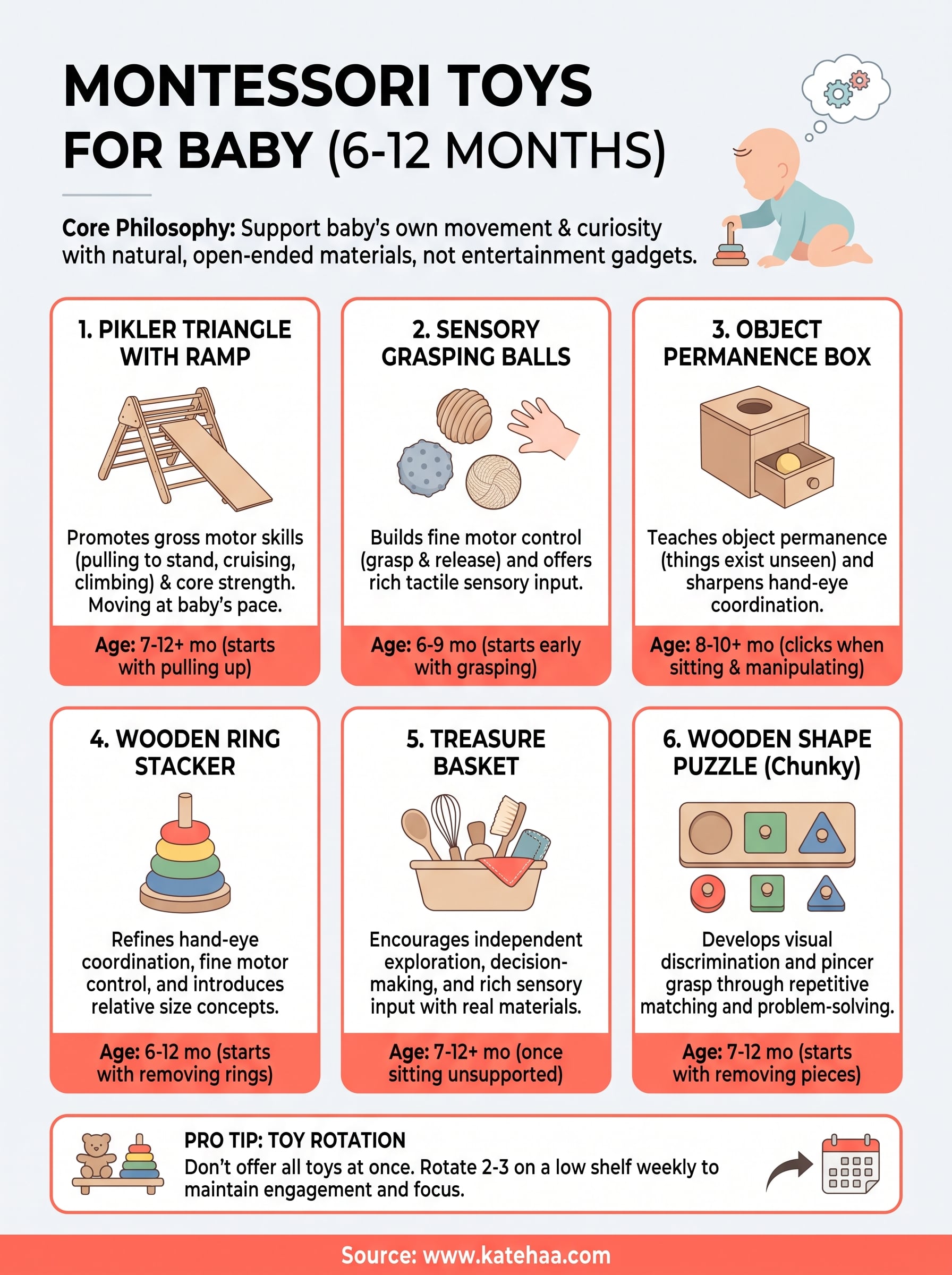
Don't buy all seven toys at once and dump them in a bin. Rotate two or three on a low, open shelf at a time, swap them out weekly, and watch which ones actually hold her attention before restocking. This rotation habit does more for engagement than any single toy on this list, and it costs you nothing but a little planning.
Every toy here earns its place because it works with your baby's own effort instead of doing the work for her. That's the whole idea behind montessori 6 months toys: give her real materials, let her set the pace, and get out of the way. The climbing pieces and grasping toys you choose now will still be in use at eighteen months, just in different ways.
If you want furniture and toys built to last through all of it, from first grasp to first climb, take a look at our full collection of Montessori-inspired toys and furniture.