

Your kid can't read the spines yet, but they know exactly which book they want. That's the whole idea behind a montessori bookshelf: books face out, covers visible, so toddlers and preschoolers pick their own stories without asking for help. A regular shelf hides everything sideways and buries the books your child actually loves under ones they never touch.
If you're hunting for the right one, you want something sturdy, low enough for small hands, and made from materials that won't wobble or splinter after a year of daily use. That's why we're focusing on options built from solid wood construction rather than flimsy laminate, including wall-mounted styles and freestanding units with storage for toys and puzzles alongside the books.
Below, we've rounded up nine picks that cover the range: a montessori bookshelf wall for tight spaces, freestanding wood shelves for playrooms, and a few with built-in storage for the rest of the clutter. We also share what to look for in terms of depth, height, and safety certification, drawing on the same craftsmanship standards we apply to our own wooden Montessori furniture at KateHaa.**
1. KateHaa Montessori bookshelf
Our own KateHaa kids bookcase with display shelves sits at the top of this list because we built it to solve the exact problem you're facing: kids who want to see the whole cover, not a spine, before they commit to a story. It's a freestanding, front-facing unit designed alongside our climbing arch rockers and learning towers, so it shares the same Scandinavian lines and child-safe finishes you'd expect from the rest of our lineup. Every piece ships from Latvia with free shipping across Europe, and you get the same assembly hardware and instructions included with our other furniture.

Materials & design
We use solid birch plywood for the shelf body, sanded smooth and finished with a water-based, non-toxic lacquer that meets EN71 safety standards for children's furniture. The design keeps a low center of gravity and rounded edges, no sharp corners for toddlers to catch a hip on. Shelf angles are tilted slightly forward so covers stay visible without books sliding off when a two-year-old grabs one in a hurry.
A bookshelf only works for a toddler if the books face forward and the whole thing can't tip when they lean on it.
Best for
This shelf suits families with toddlers through early elementary kids, roughly 1 to 8 years old, who need a shelf that grows with their reading habits. It works well in a playroom, a bedroom corner, or a shared reading nook, and it pairs naturally with our Pikler triangles and play cubes if you're building out a full Montessori-style space. Parents who want one shelf that handles both picture books and the first chapter books their kid starts hoarding will get the most mileage from it.
Storage & capacity
The unit holds roughly 20 to 25 picture books face-out across its tiers, with a lower open cubby for oversized board books or a few puzzles. Here's how it breaks down against typical room needs:
| Feature | Detail |
|---|---|
| Length | 76 cm / 29.9 in |
| Width | 40 cm / 15.75 in |
| Height | 82 cm / 32.3 in |
| Book capacity | 20-25 titles |
| Extra storage | 1 open cubby |
| Max child age | Up to 8 years |
That lower cubby is where most parents end up stashing stuffed animals or a stack of magazines once the book collection outgrows the top shelves.
Price range
This shelf is available at €175. This is a furniture-grade investment meant to last through a second or third child, not a one-season purchase. You can browse current options and finishes directly in our full range of KateHaa kids furniture and toys.
2. Wall-mounted Montessori bookshelf
Space-strapped nurseries and shared kids' rooms rarely have floor room for a freestanding unit, and that's exactly where a wall-mounted montessori bookshelf earns its spot on this list. These shelves bolt directly into wall studs, keeping the floor clear for a rug, a reading cushion, or a toy bin, which matters most in apartments or smaller bedrooms where every square foot counts. Because the shelf floats above baseboard height, it also dodges the usual toddler habit of climbing on furniture to reach the top tier.
Materials & design
Most quality versions use solid pine or birch slats with a simple ledge-and-rail design, letting book covers lean forward against a thin front lip instead of sitting in a boxed cubby. Finishes tend toward natural oil or clear lacquer rather than paint, since the wood grain shows through and the shelf reads as a design piece rather than a plastic add-on. Look for rounded corners and pre-drilled mounting holes rated for stud installation, not just drywall anchors, because a toddler will eventually hang off the edge.
A wall shelf only earns its keep if it's anchored into studs, not just drywall, since kids treat every ledge as a handhold.
Best for
Parents furnishing a nursery or shared bedroom where floor space is tight get the most value here, especially when a crib, changing table, and dresser already claim most of the room. It also suits families who want to install several shelves at staggered heights, one lower row a toddler can reach and a higher row that grows with them as they get taller.
Storage & capacity
A single montessori wall bookshelf rail typically holds 8 to 12 books face-out, and most parents install two or three rails stacked to multiply capacity without eating floor space. There's no cubby storage built in, so toys and puzzles need a separate bin nearby.
Price range
A single rail runs €20 to €45, making a three-rail setup land somewhere between €60 and €135 once you factor in mounting hardware. That's cheaper than most freestanding units, though you'll need basic tools and the confidence to drill into a wall.
3. Wooden tiered front-facing bookshelf
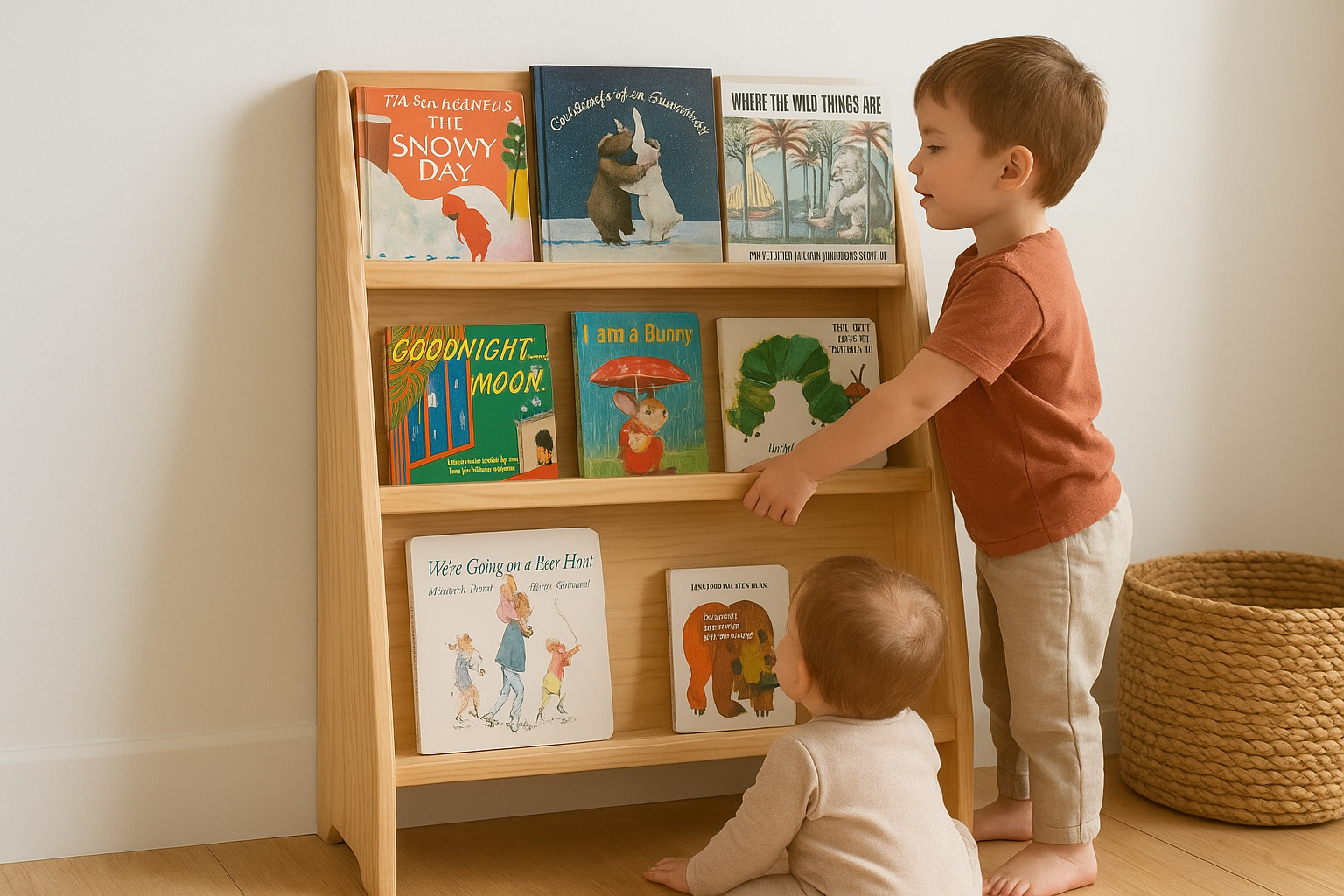
Some parents skip the wall entirely and want a freestanding piece that just does one job well: hold books face-out at tiered heights so a toddler and an older sibling can both reach their level. A wooden tiered front-facing bookshelf stacks two or three angled shelves in a staircase pattern, with the lowest tier scaled for a crawling one-year-old and the top tier reachable by a six or seven-year-old standing on tiptoe. It's the simplest version of a Montessori shelf you'll find, no cubbies, no drawers, just tiers built for browsing.
Materials & design
These shelves are almost always built from solid pine, birch, or beech, chosen for its light weight relative to strength since the whole unit needs to stay stable without becoming too heavy to reposition. Tiers are cut at a forward lean, usually 10 to 15 degrees, so covers rest flat against a lip rather than sliding to the floor. Good versions round every edge and corner, skip metal brackets in favor of dowel joinery, and use a matte, food-safe finish that won't peel when a toddler chews the rail.
A tiered shelf works because the shortest kid in the house always gets a tier they can actually reach without climbing.
Best for
Households with siblings spanning several years get the most out of this style, since each tier effectively becomes a personal shelf height for a different age. It also suits Montessori classrooms and home learning corners, where a toddler-height table and a shared reading nook see multiple kids rotate through the same space all day.
Storage & capacity
Capacity depends on tier count, but a typical three-tier unit holds books as shown below:
| Tier | Height from floor | Approx. book capacity |
|---|---|---|
| Bottom | 15 cm | 8-10 books |
| Middle | 35 cm | 8-10 books |
| Top | 55 cm | 6-8 books |
That totals 22 to 28 books across the unit, with no dedicated toy storage, so plan on a separate bin if puzzles and blocks need a home too.
Price range
Expect €70 to €130 for a solid wood three-tier unit from a furniture-focused brand, with laminate or MDF versions dipping closer to €40. Given how much daily handling these shelves take, solid wood earns back its higher price in years of use rather than a single season before the joints loosen.
4. Montessori bookshelf with toy storage
Books rarely stay alone in a kid's room for long. Crayons, puzzle boxes, and a stray stuffed animal always end up wherever the books live, so a montessori bookshelf with storage solves both problems in one piece of furniture instead of forcing you to buy a second unit. This style combines the classic face-out book tiers with one or two enclosed cubbies or open bins underneath, much like a three-section toy shelf, giving toys a designated home instead of a pile on the floor.
Materials & design
Manufacturers typically build the book tiers from solid birch or pine, then add a lower section made from plywood panels cut into open cubbies or fitted with removable fabric bins. The forward-tilted book ledges sit on top, while the storage section below uses a flat, sturdy base that can take the weight of blocks, board games, or a small basket of cars. Better versions round every exposed edge and skip particleboard entirely, since particleboard swells and sags once bins get shoved in and out daily.
A shelf that stores books and toys in one footprint means fewer pieces of furniture cluttering a small room.
Best for
This style suits parents consolidating a playroom who don't have space for a separate bookshelf and toy chest. It also works well for families doing a full Montessori-style room setup, where books, puzzles, and open-ended toys chosen by age and stage all need to sit within a toddler's reach without a mess of loose bins scattered across the floor.
Storage & capacity
A standard two-tier version with a storage base breaks down roughly like this:
| Section | Capacity |
|---|---|
| Upper book tiers | 12-18 books |
| Lower cubby (2 slots) | 2 medium bins or baskets |
| Total footprint | Similar to a single bookshelf |
That lower cubby typically fits standard 30 cm wide fabric bins, so you're not stuck hunting for oddly sized storage boxes.
Price range
Expect to pay €90 to €160 for a solid wood version with storage bins included, compared to €150 to €220 for similar combo units built with designer finishes or custom paint options. Laminate versions run cheaper, around €50 to €80, but the bins tend to wear out the attachment points faster than solid wood construction does.
5. Compact Montessori bookshelf for small rooms
Tiny bedrooms and shared nurseries don't need a scaled-down toy, they need a compact montessori bookshelf that does the same job as a full-size unit in half the width. This style trims the footprint to roughly 40 to 45 cm wide while keeping the forward-facing tiers intact, so a toddler still browses covers instead of spines, just from a shelf that tucks into a corner, much like a corner shelf built for tight layouts, or slides beside a crib without blocking a door swing. It's the pick for parents who love the Montessori setup but genuinely don't have the floor space for a wider freestanding piece.
Materials & design
Builders keep these units light by using thin-profile solid birch or pine, usually 12 to 15 mm panels instead of the thicker stock used in larger shelves, since a smaller footprint doesn't need the same structural mass to stay stable. Two tiers is standard here rather than three, with a shallow depth of around 15 cm so the whole thing hugs the wall instead of jutting into walking space. Rounded corners and a matte finish stay non-negotiable regardless of size, because a smaller shelf still sits at exactly toddler-hip height.
A small shelf still needs the same rounded edges and stable base as a big one, size never excuses cutting corners on safety.
Best for
This option fits studio apartments, shared sibling rooms, or a reading nook squeezed into a hallway where a standard-width unit simply won't clear the walkway. It also works well as a second shelf near a play mat when the main bookshelf already lives across the room and you want a few favorite titles within arm's reach.
Storage & capacity
Expect these compact units to hold noticeably fewer titles than full-size shelves, as shown here:
| Feature | Detail |
|---|---|
| Width | 40-45 cm |
| Depth | 15 cm |
| Book capacity | 10-14 titles |
| Toy storage | None |
That capacity works fine for a rotating selection, since most Montessori setups swap books out weekly anyway rather than displaying an entire library at once.
Price range
Compact solid wood versions run €55 to €90, a bit less than full-width units simply because they use less material. Skip anything under €35 in this category, since that price point almost always means thin MDF that won't survive a toddler leaning on the top tier.
6. Expandable Montessori bookshelf for growing libraries
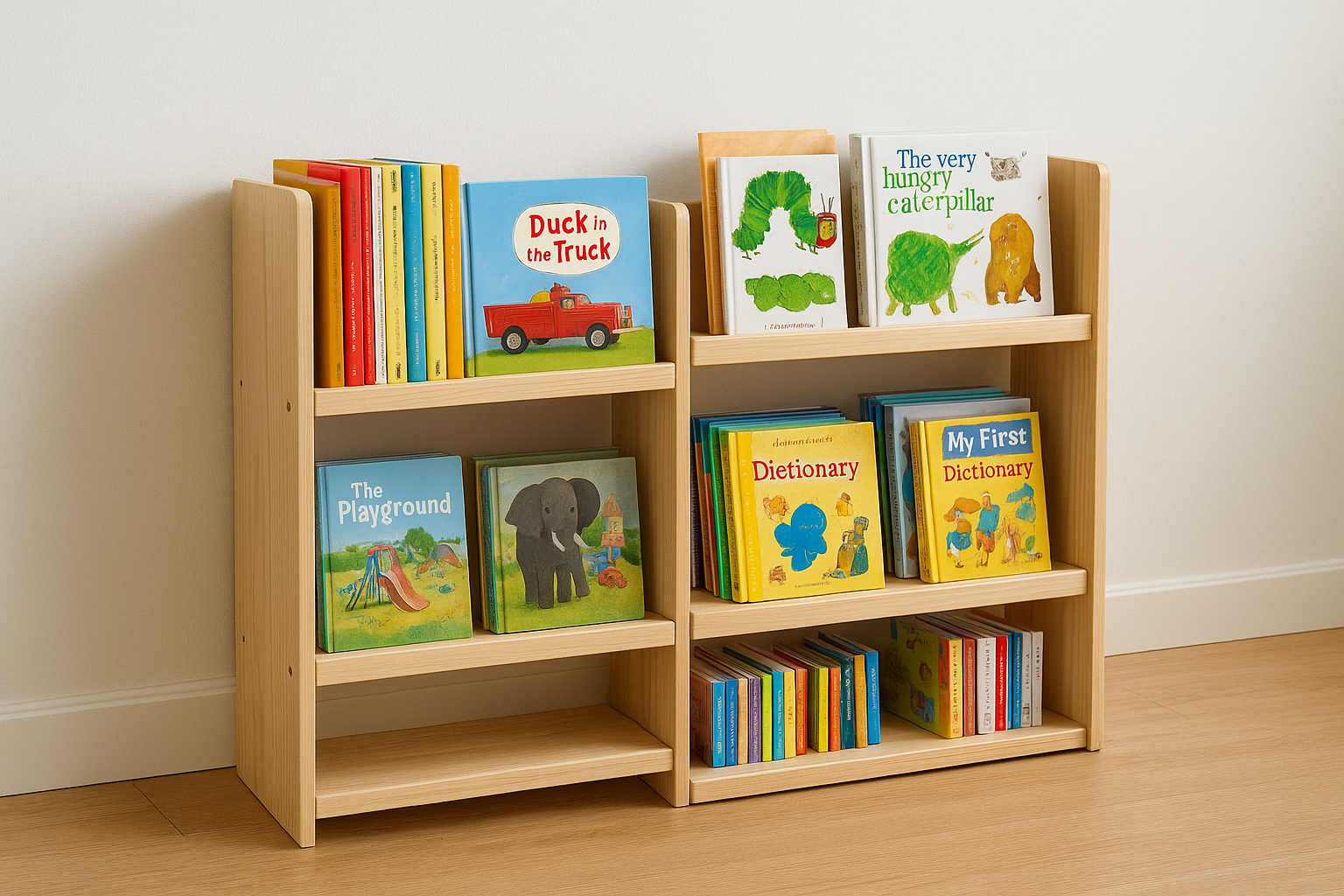
Book collections never stay the same size for long. A toddler's ten favorite board books turn into forty picture books by kindergarten, and a fixed-width shelf that fit fine at two years old runs out of room fast. An expandable montessori bookshelf solves that by using modular sections you can bolt together side by side or stack vertically, so the shelf grows in step with the library instead of forcing a whole new purchase every year.
Materials & design
These systems use solid wood modules, usually birch or pine, each built as a self-contained tier with its own forward-facing lip and pre-drilled connector holes on the sides. You buy a starter unit, then add matching modules later, either from the same brand or a compatible width such as a five-section shelf for bigger collections, and join them with the same dowel-and-bolt hardware included in the original box. Good versions keep every module the same depth and height so the finished wall of shelving looks uniform rather than mismatched once you've added a third or fourth section.
A shelf that expands means you're buying a system once, not replacing furniture every time the book pile outgrows it.
Best for
This style suits families expecting a fast-growing book collection, whether that's from a voracious early reader, multiple kids sharing one shelving wall, or parents who simply know they'll keep adding titles for years. It also works well for home educators and Montessori practitioners rotating larger book sets seasonally, since extra modules can hold a rotating selection while the core shelf stays put.
Storage & capacity
Capacity scales directly with how many modules you own, which makes planning ahead straightforward:
| Setup | Modules | Approx. book capacity |
|---|---|---|
| Starter | 1 | 10-12 books |
| Mid-size | 2 | 20-24 books |
| Full wall | 4 | 40-48 books |
Most parents start with one or two modules and add a third once the shelf visibly overflows, which usually happens faster than expected once a child starts requesting library hauls weekly.
Price range
A single starter module typically costs €60 to €90, with each additional module priced similarly rather than discounted, so a four-module wall lands between €240 and €360 total. That's a bigger investment than a one-piece shelf, but it beats buying and discarding smaller units as your kid's reading habit outpaces the furniture.
7. Budget-friendly Montessori bookshelf
Not every family needs furniture-grade birch on day one, especially when a toddler is still testing whether books belong on a shelf or on the floor. A budget-friendly montessori bookshelf gets the front-facing concept right without the premium price tag, using lighter materials and simpler joinery to hit a lower cost while still keeping covers visible and edges rounded. This category exists for parents who want to try the Montessori approach before committing to a pricier upgrade later.
Materials & design
Expect MDF or thin plywood panels instead of solid birch or pine, often finished with a painted coat rather than exposed wood grain. Corners are usually rounded with a router pass rather than hand-sanded, and joinery relies on cam bolts and pre-drilled holes instead of dowels, which keeps assembly fast but means the joints loosen faster under daily handling. Weight stays low, which helps if you're repositioning the shelf between rooms but also means it tips more easily than a solid wood unit.
A budget shelf earns its price by skipping decoration, not by skipping the rounded edges and stable base that keep a toddler safe.
Best for
This option suits first-time buyers testing the Montessori setup, renters who move often and don't want to haul solid wood furniture between apartments, or a secondary shelf in a playroom where the main collection already lives elsewhere. It's also a reasonable pick for grandparents' houses, where books only need a home for occasional weekend visits rather than daily use.
Storage & capacity
Most budget units hold a modest but workable collection:
| Feature | Detail |
|---|---|
| Width | 45-55 cm |
| Material | MDF or thin plywood |
| Book capacity | 10-16 titles |
| Toy storage | Rarely included |
That capacity handles a rotating weekly selection fine, though the thinner shelving means you'll want to avoid stacking oversized board books more than two deep per slot.
Price range
Expect to pay €30 to €55 for a painted MDF version from a mainstream retailer, occasionally dipping under €25 during sales. Treat this as a starter piece rather than a long-term investment. Once a second child starts using the same shelf, the joints and paint finish usually show wear that a solid wood unit wouldn't.
8. Handcrafted designer Montessori bookshelf
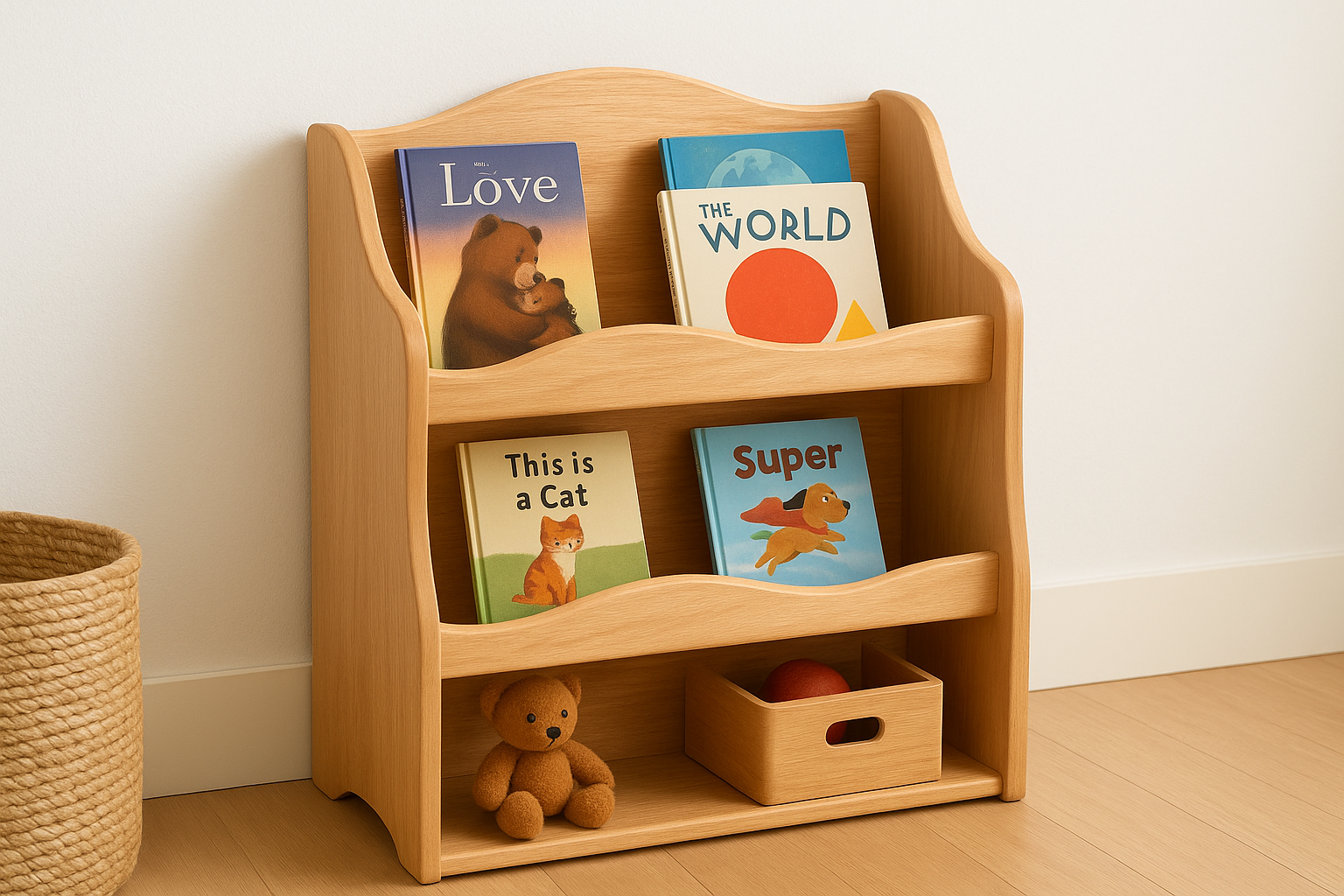
Some parents want a bookshelf that doubles as a piece of furniture the whole room is built around, not just a functional holder for board books. A handcrafted designer montessori bookshelf delivers that, with sculptural shapes, curved cutouts, or asymmetric tiers that read more like a piece from a furniture showroom than a kids' accessory. These pieces come from small workshops rather than mass production lines, so you're paying for a designer's eye and a craftsman's hands, not just raw material cost.
Materials & design
Expect solid oak, ash, or birch with joinery cut by hand rather than machine-drilled cam bolts, often finished in a natural oil that highlights grain rather than hiding it under paint. Designers in this category tend to experiment with shape, a wave-cut top edge, a rounded arch cutout, or asymmetric tier heights, while still keeping every corner rounded and every edge sanded smooth for small hands. Because these shelves get built in small batches, you'll often find limited color runs or the option to request a custom stain to match existing furniture.
A designer shelf earns its price through the hours of hand-finishing, not through the wood costing more.
Best for
This style suits parents who treat the nursery or playroom as a design project, not just a functional space, and who want a heirloom-quality piece that photographs as well as it performs. It also fits families planning to keep the shelf long after their kid outgrows picture books, repurposing it later as a display shelf or entryway piece.
Storage & capacity
Most designer units prioritize visual presence over maximum book count, typically holding 15 to 20 titles across two or three sculpted tiers. Dedicated toy storage is rare here since the design language usually stays deliberately minimal, so pair it with a separate bin if you need to house puzzles too.
Price range
Expect €180 to €350, occasionally higher for one-off commissioned pieces from a named designer or workshop. That's a meaningful step up from mass-market solid wood shelves, but you're paying for limited production runs, hand-finishing, and a piece built to last well past the toddler years.
9. DIY Montessori bookshelf plans
Some parents skip buying altogether and build their own montessori bookshelf wood project from a weekend's worth of lumber and a printable plan. This route suits anyone comfortable with a saw and a drill, and it's the only option on this list where the final size, tier count, and finish are entirely up to you. Free and paid plans circulate widely among woodworking and Montessori parenting communities, ranging from a simple two-tier ledge to a full modular wall system.
Materials & design
Most plans call for 1x4 or 1x6 pine boards, plywood for the back panel, and basic wood glue plus screws or dowels for joinery. You'll need a miter saw or circular saw for angle cuts, a sander or sanding block for rounding corners, and a non-toxic finish like raw linseed oil or a water-based lacquer rated for children's furniture. Skip stain with heavy solvents, since toddlers chew rails and edges more than parents expect.
A DIY shelf is only as safe as its weakest joint, so glue and screw every connection, don't rely on friction fit.
Best for
This option fits hands-on parents with basic woodworking tools who want a custom width to fit an odd nook, or who simply enjoy building furniture themselves rather than assembling flat-pack pieces. It also suits budget-conscious families willing to trade a weekend of labor for a lower material cost than a finished retail unit.
Storage & capacity
Capacity depends entirely on your plan, but a typical DIY two-tier build holds:
- Bottom tier: 8-10 books
- Top tier: 6-8 books
- Optional side bin: extra toys or puzzles
Building wider or adding a third tier scales capacity up without much extra cost, since lumber is the cheapest material on this list.
Price range
Expect to spend €25 to €50 on lumber, hardware, and finish for a basic two-tier build, plus your own time. That undercuts even the budget-friendly retail option, though you're trading a lower price for the hours spent cutting, sanding, and finishing the wood yourself, and for a final product that won't carry a manufacturer's safety certification.
Picking the right shelf for your child's space
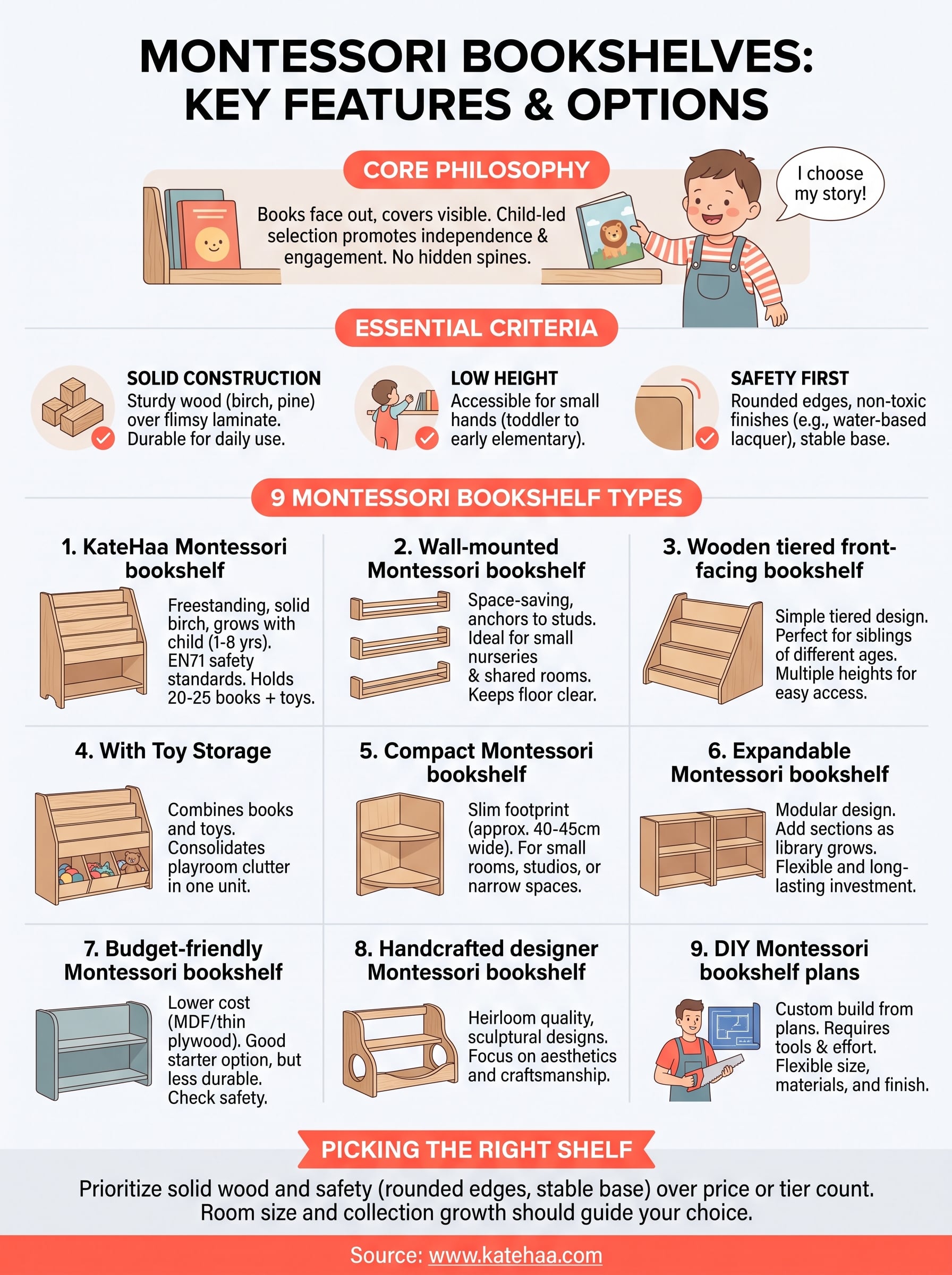
Every option here solves the same problem in a different way: get books facing out, at a height your kid can reach, without the whole thing tipping over. Room size decides more than budget does. A wall-mounted rail wins in a nursery with no floor space, while a full-size montessori bookshelf with storage makes more sense once you're consolidating a whole playroom. Growing families should lean toward expandable or tiered designs instead of buying a new shelf every year.
Skip anything under a certain price point regardless of style. Thin MDF and unrounded corners cause more return trips than they save in upfront cost. Solid wood, rounded edges, and a stable base matter more than tier count or finish color.
If you want that combination without guessing on dimensions or safety standards, shop Montessori storage shelves and bookshelves for children and pick a size that fits your space.