

Toys pile up fast, and by the time you've stepped on your third stray block this week, you're probably searching for toy storage wood solutions that actually hold up and look good in a kid's room. Plastic bins crack, stack badly, and rarely match anything in your home. Wood does the opposite: it ages well, handles rough daily use, and blends into your decor instead of fighting it.
If you're weighing a wood toy storage rack against open shelves, or wondering whether drawers or baskets make more sense for your space, this guide walks through ten real options with clear pros and cons for each. We cover everything from a simple toy storage rack for books and bins to a full toy storage drawers system for smaller items like blocks and figurines.
As a family that builds Montessori-inspired wooden furniture ourselves, we know what separates a storage piece that lasts a decade from one that wobbles after six months. Read on for ideas you can actually use, whether you're outfitting a nursery, a playroom, or a shared kids' bedroom.
1. Open wooden shelving with Montessori-style bins
Low, open shelving is the backbone of most Montessori playrooms, and for good reason. Instead of dumping everything into one deep bin where toys get lost and forgotten, you place a handful of items on each shelf, visible and reachable at a toddler's eye level. This is the classic toy storage rack approach: a simple frame, a few horizontal shelves, and enough open space that a two-year-old can see her options and put things back without help. It's less about hiding clutter and more about teaching kids to manage their own things.

Open shelving doesn't just store toys, it teaches kids to choose, use, and return them on their own.
Key features
Good Montessori-style shelving keeps a few things consistent: low overall height (usually under 32 inches so toddlers can reach the top shelf), rounded edges, and a shallow depth of 10 to 12 inches so items don't get buried three-deep. Solid wood construction matters here more than in almost any other storage type, because open shelves take direct impact when a child climbs, leans, or pulls a bin off the edge. Look for:
- Kiln-dried solid wood or quality plywood, not particleboard
- A finish that's non-toxic and safe for mouthing toddlers
- Bins sized to match shelf depth exactly, so nothing tips forward
- A base wide enough to resist tipping when a bin is removed from the top shelf
Our own Montessori shelving units are built this way on purpose, with a shallow footprint and rounded corners that hold up to years of daily handling.
Best for
This format suits toddlers and preschoolers, roughly ages 1 to 5, who are still learning to sort and categorize their own belongings. It works especially well in a wood toy storage setup for open-ended materials like wooden blocks, stacking rings, board books, and puzzles, since each item gets its own visible spot. Families following Montessori or Reggio Emilia approaches tend to favor this style specifically because it removes the need for an adult to dig through bins on the child's behalf.
Where it struggles is with small, loose pieces. Loose crayons, tiny figurines, or puzzle sets with dozens of parts belong in something with a lid or a drawer front, not an open bin that tips over during play. For those items, pair the shelf with a few of the toy storage drawers covered later in this list.
Price range
Budget matters here, and quality solid wood shelving spans a wide range depending on size and material.
| Type | Typical price |
|---|---|
| Small 2-shelf unit (basic pine) | €60 to €120 |
| Mid-size 3-shelf unit with bins | €150 to €280 |
| Larger furniture-grade unit, custom finish | €280 to €450+ |
Expect to pay more for solid hardwood over softwood, and more again for custom sizing or matched color finishes that coordinate with other furniture in the room.
2. Modular cube storage with wood or fabric bins
Cube storage systems trade the fully open look of Montessori shelving for a grid of square compartments, each sized to hold one bin. You've likely seen these in big-box stores: a wooden or laminate frame divided into nine or sixteen equal cubes, with fabric or wood bins that slide in and out. The modular part matters most here. Most systems let you stack, extend, or rearrange units as your child's toy collection grows, so a single 2x2 grid in a nursery can become a 3x4 wall in a few years without buying a whole new piece.
Key features
What separates a decent cube unit from a flimsy one usually comes down to the frame material and how the bins fit. Cheap versions use thin MDF panels that sag under weight within a year. Better ones use solid wood or thick plywood with reinforced corners. Check for:
- Solid wood or void-free plywood frame, not hollow-core board
- Bins that fit snugly, so they don't slide out on their own
- Rounded or beveled cube openings, since little hands and heads bump into these constantly
- A stackable design if you plan to expand later
A cube system only stays useful if the bins actually fit the cubes, loose or oversized bins fall out within weeks.
Best for
Modular cube storage works well for households with more than one child sharing a room, since color-coded bins let each kid claim their own section. It also suits families who expect to move or reconfigure furniture often, because the grid disassembles and travels more easily than a fixed shelving unit. Skip it if you're aiming for a strictly Montessori setup, since closed bins hide contents the way open shelves don't.
Price range
Pricing depends heavily on frame material and bin quality.
| Type | Typical price |
|---|---|
| Basic laminate cube unit, no bins | €40 to €90 |
| Solid wood frame with fabric bins | €120 to €220 |
| Large modular wall system, multiple units | €250 to €400+ |
3. Classic wooden toy chests with hinged lids
Toy chests are the storage piece most of us grew up with, and they still earn their spot in a kids' room for one simple reason: capacity. A single chest swallows stuffed animals, dress-up costumes, and oversized toys that never fit neatly into a bin or drawer. Unlike the open shelving in our first entry, a chest hides everything behind a lid, which makes it the fastest way to clear a floor before guests arrive, even if it does less to teach sorting habits.

Key features
Safety hardware separates a well-made chest from a dangerous one. Soft-close hinges are non-negotiable, since a heavy lid slamming on small fingers is one of the most common toy-storage injuries reported by pediatric safety groups. Look for these details before buying:
- Slow-close or hydraulic hinges that can't slam shut
- Ventilation holes or gaps, in case a child climbs inside
- No latch or lock that could trap a child
- Solid wood construction rated to hold a child's weight if they sit or stand on the lid
A toy chest without soft-close hinges is a hazard waiting to happen, check the hardware before you check the price tag.
Best for
Chests suit families who need to store bulky, irregular items like plush toys, blankets, or costumes that don't fit standard bins. They also work well for households prioritizing a wood toy storage solution that doubles as a bench or coffee table in a shared living space. They're less ideal for toddlers still learning independence, since digging through one deep compartment defeats the visibility that open shelving provides.
Price range
| Type | Typical price |
|---|---|
| Basic pine chest, no hinge damper | €80 to €140 |
| Solid hardwood chest with soft-close hinge | €160 to €280 |
| Furniture-grade custom chest | €280 to €400+ |
Spend the extra amount for hinge safety. It matters more than finish or wood species.
4. Rolling wooden toy carts and storage drawers
A rolling cart solves a problem fixed shelving can't: toys that need to move between rooms. Picture a three-tier wooden cart on locking casters, loaded with art supplies in the playroom, then wheeled into the kitchen for a tabletop craft session, then parked back in a corner when playtime ends. This category also covers stacked toy storage drawers on wheels, which work like a mini dresser for small items such as crayons, dice, or building blocks that would scatter across an open shelf.
Key features
Wheels are the whole point here, so their quality decides whether the cart earns its keep. Cheap plastic casters crack under a loaded cart within a year; locking wheels made of rubber or nylon hold up far longer and stop the cart from rolling off on an uneven floor. Beyond the wheels, check for:
- Locking casters on at least two of the four wheels
- Solid wood drawer boxes with dovetail or dowel joints, not stapled particleboard
- Smooth-glide drawer slides rated for repeated daily use
- A low center of gravity so a full top drawer doesn't tip the unit
A rolling cart is only as good as its wheels, cheap casters turn a handy cart into a stuck one within months.
Best for
Rolling storage suits smaller rooms where furniture needs to serve more than one purpose, and it works especially well for wood toy storage of loose, small items like markers, magnetic tiles, or puzzle pieces that belong in individual drawers rather than one shared bin. Families who split playtime between a bedroom and a living room benefit most, since the cart travels with the child instead of leaving toys stranded in one spot. Skip it in homes with thick carpet, since wheels drag rather than roll on plush flooring.
Price range
| Type | Typical price |
|---|---|
| Small 3-drawer rolling cart, basic wood | €70 to €130 |
| Mid-size cart with locking casters | €140 to €220 |
| Furniture-grade multi-drawer unit | €230 to €350+ |
Pay attention to drawer slide quality over drawer count. A cart with three smooth drawers beats one with five sticky ones every time.
5. Wall-mounted wooden toy racks and shelves
Floor space disappears fast in a small kids' room, and a wall-mounted rack solves that problem without sacrificing storage. Unlike the freestanding shelving in our first entry, these pieces attach directly to studs, freeing up the entire floor for a play mat, a rocking horse, or just room to run. This is one of the most space-efficient forms of toy storage wood you can install, since it turns unused vertical wall space into functional shelving without adding a single square foot of footprint.
Key features
Mounting hardware makes or breaks this category, so don't skip it to save a few euros. A rack that isn't anchored into wall studs, not just drywall anchors, can pull loose under repeated tugging from a curious toddler. Look for:
- Solid wood construction rated for at least 20 to 30 lbs per shelf
- Pre-drilled stud-mounting holes, not just adhesive strips
- Rounded shelf edges and corners
- A low mounting height, roughly 18 to 30 inches off the floor, so kids can reach without climbing
A wall-mounted shelf is only safe if it's bolted into studs, anchors alone won't hold against a determined toddler.
Best for
Wall racks suit nurseries and shared bedrooms where floor space is tight and every square foot counts. They also work well as wood toy storage rack displays for books, stuffed animals, or a rotating selection of toys you swap out weekly to keep playtime fresh. They're a poor fit for renters worried about wall damage, and for very young toddlers who might pull a low shelf down while standing.
Price range
| Type | Typical price |
|---|---|
| Single small wall shelf | €30 to €60 |
| Set of 3 to 4 matching racks | €90 to €160 |
| Custom-sized wall shelving system | €180 to €300+ |
Buy sets rather than single shelves if you can. Matching pieces look intentional instead of like an afterthought.
6. Under-bed wooden toy storage drawers
Every kids' room has one resource nobody uses well: the space under the bed. Under-bed wooden toy storage drawers turn that gap into real capacity without adding a single piece of furniture to the floor plan. These are shallow, wide drawers on casters, sized to slide beneath a standard twin or full bed frame, and they're a smart fit for small bedrooms where every square foot of floor already has a job. Think of them as toy storage drawers for the toys you use less often, like seasonal items, extra blocks, or a rotating stash you swap in every few weeks.
Key features
Clearance is the deciding factor here, so measure your bed frame's underside height before buying anything. Solid wood drawer boxes hold up far better than the cardboard or thin MDF versions sold for closet storage, since kids drag these in and out constantly. Look for:
- A drawer height under 7 inches for standard bed frames
- Smooth rolling casters rated for the drawer's loaded weight
- Solid wood or plywood construction, not folding fabric
- A finger-friendly pull or handle, not a sharp metal loop
Under-bed drawers only work if they roll smoothly, a stiff drawer gets ignored and the clutter ends up back on the floor.
Best for
This format suits older kids, roughly ages 5 and up, who can manage pulling a drawer out and pushing it back in without help. It works especially well as overflow wood toy storage for families who've already filled open shelving and need a second tier for less-used items. Skip it for toddlers, since low bed clearance and rolling drawers near a crawling child aren't a safe combination.
Price range
| Type | Typical price |
|---|---|
| Basic single drawer | €40 to €70 |
| Pair of matching wood drawers | €90 to €150 |
| Custom-sized set for platform beds | €160 to €250+ |
Measure twice before ordering. A drawer that's a half-inch too tall simply won't fit.
7. Storage benches with hidden toy compartments
A storage bench does two jobs at once: it seats a kid pulling on shoes by the door, and it swallows toys under a padded or flat lid. Unlike the toy chests covered earlier, a bench is built to sit low and sturdy against a wall, so it doubles as extra seating for reading time or a spot for guests during a playdate. This makes it one of the more versatile forms of toy storage wood on this list, since it earns its floor space in a living room or entryway, not just a bedroom.
A bench that also stores toys pulls double duty, so it earns its footprint in rooms where a dedicated toy chest wouldn't fit.
Key features
Weight capacity matters most here, since a bench gets sat on daily, sometimes by more than one kid at once. Look for:
- A solid wood seat rated to hold at least 200 lbs
- Soft-close or hydraulic hinges, same as any lidded chest
- A flat, cushioned top if you want it to double as extra seating
- Enough internal depth to hold bins, not just loose toys
Solid hardwood construction beats a laminated MDF shell here, since MDF benches tend to sag in the middle within a year or two of regular sitting.
Best for
Storage benches suit entryways, mudrooms, and shared living spaces where you want seating and storage without a dedicated toy chest taking up room. They work well for families organizing outdoor gear like boots and jackets alongside a few toys, and for households that want one wood toy storage piece that doesn't look like a kids' item in a shared space. They're a weaker fit for toddlers who need visibility into their toy options, since a closed bench hides contents the same way a chest does.
Price range
| Type | Typical price |
|---|---|
| Basic wood bench, no cushion | €70 to €120 |
| Cushioned bench with soft-close hinge | €140 to €240 |
| Furniture-grade custom bench | €250 to €380+ |
Cushioned tops cost more but see far more daily use than a bare wood seat.
8. Combination bookshelf and toy organizers
Books and toys rarely stay separated in a real playroom, so a hybrid piece that handles both earns its keep fast. These units pair vertical book slots, the kind that display covers forward rather than spines out, with a lower row of cubbies or bins for blocks, cars, and stuffed animals. It's a practical middle ground between the open shelving in our first entry and the closed cube system in our second, giving you visual browsing for books and contained storage for everything else in one toy storage wood piece.
Key features
Proportion is what makes or breaks this hybrid design. The book slots need enough depth to hold a picture book upright without it sliding sideways, while the lower cubbies need to be shallow enough that toys stay visible instead of piling up. Look for:
- Angled or slotted book display shelves, not flat shelves that stack books flat
- Lower cubbies sized for standard bins, roughly 10 by 10 inches
- A stable, wide base since kids lean on these units to grab books
- Solid wood or plywood construction rather than laminated fiberboard
A bookshelf that also organizes toys keeps reading material visible while everything else stays contained below it.
Best for
This format suits families who read with their kids daily and want books treated as a featured item, not buried on a spine-out shelf where covers get ignored. It also works well as a bedroom centerpiece for kids aged 2 to 8, since the lower cubbies grow with a rotating toy collection while the book section stays useful for years longer than most wood toy storage pieces. Skip it if your child's collection leans heavily toward oversized toys, since the compact cubbies won't fit much beyond books and small bins.
Price range
| Type | Typical price |
|---|---|
| Small combo unit, basic wood | €90 to €150 |
| Mid-size unit with matching bins | €160 to €260 |
| Furniture-grade custom combo shelf | €270 to €400+ |
Expect to pay a premium over a plain bookshelf, since the added cubbies require more precise joinery.
9. Stackable wooden crates and baskets
Crates skip the built-in frame entirely and let you build your own storage wall one box at a time. Each wooden crate stands alone, but stack four or six together and you get a modular grid that looks intentional without any hardware or wall mounting. This is the most flexible toy storage wood option on the list, since you can rearrange, add, or remove crates as your kid's collection shifts from oversized stuffed animals to small building sets.
A stack of crates grows or shrinks with your kid's toy collection, no other storage type adapts that easily.
Key features
Joinery is what separates a crate that lasts from one that splits after a season of stacking. Cheap glued corners pull apart under repeated loading and unloading. Look for:
- Dovetail or notched corner joints, not butt-glued panels
- Slatted or solid sides, depending on whether you want ventilation or a fully closed look
- Cutout handles on the sides for easy carrying between rooms
- A consistent size across crates so stacks stay level and stable
Finish quality matters too, since crates get handled constantly and a rough edge catches little fingers fast.
Best for
Small spaces benefit most from this format, since crates stack vertically instead of spreading across the floor like a fixed shelf would. Renters also favor crates, because nothing needs mounting to a wall or anchoring to a stud. Toddlers and preschoolers do well with open-top crates specifically, since the visibility mirrors the Montessori shelving covered earlier in this list, while older kids can handle lidded versions for smaller loose pieces.
Price range
| Type | Typical price |
|---|---|
| Single basic wood crate | €20 to €45 |
| Set of 3 to 4 matching crates | €70 to €130 |
| Furniture-grade custom crate set | €140 to €220+ |
Buying crates in matched sets costs a bit more upfront but keeps stacks looking uniform instead of mismatched over time.
10. Playhouses and activity cubes with built-in storage
A playhouse earns its floor space by doing more than any single shelf or bin ever could. These builds fold out into a small house, fort, or activity cube, and most versions tuck a bench, shelf, or bin compartment into the base structure itself. Instead of buying a playhouse and a separate storage unit, you get both in one toy storage wood piece that doubles as the centerpiece of the room rather than a corner afterthought. Our own Build and Play playhouses fold flat for storage or travel, then open into a full activity cube with built-in shelving for books, bins, and small toys.
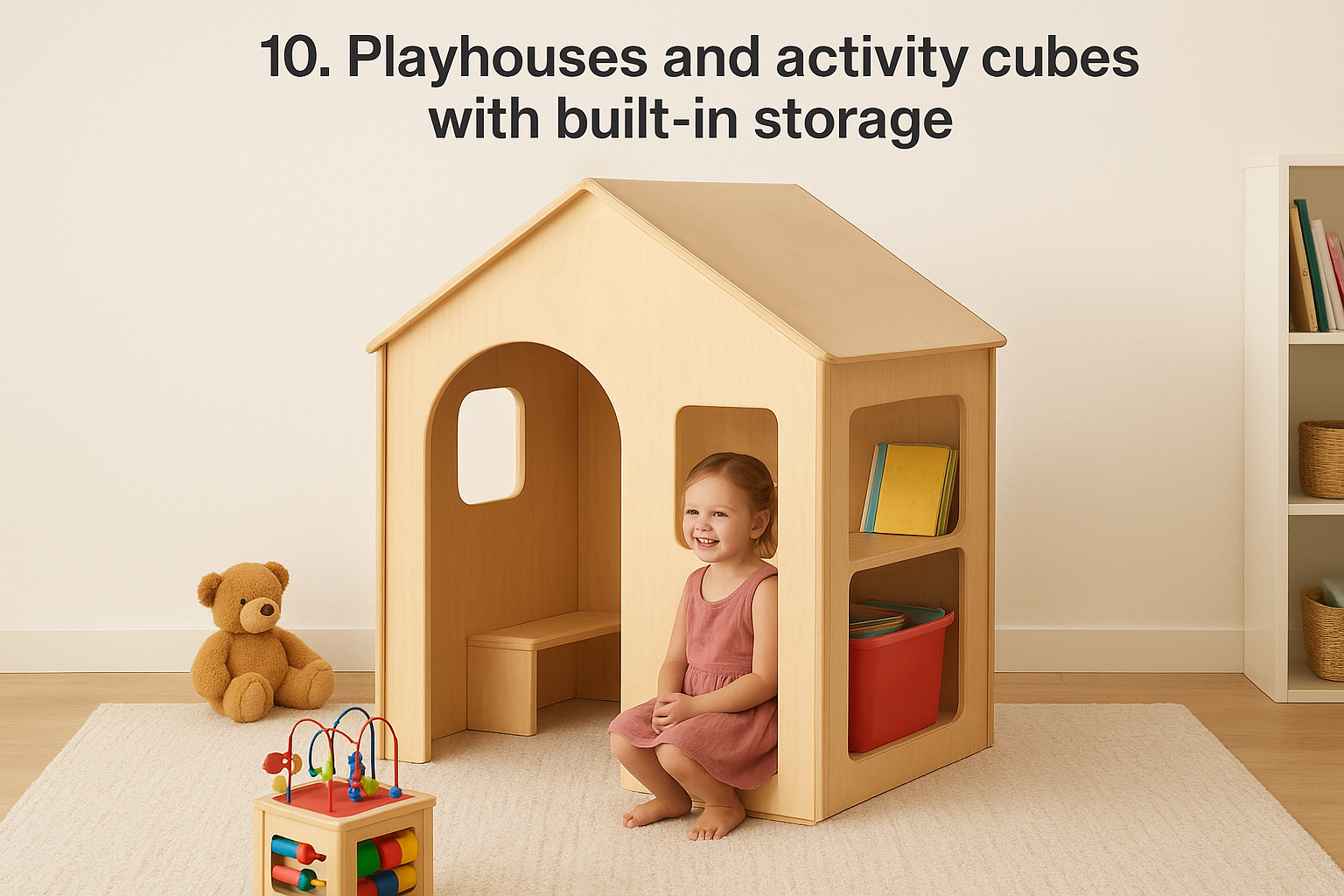
A playhouse with built-in storage turns cleanup into part of the game instead of a chore that happens after it.
Key features
Fold-flat hinges matter most in this category, since a bulky playhouse that can't collapse eats floor space year-round. Beyond that, check for:
- Solid wood panels rated to hold a child's weight if they climb or sit inside
- Built-in shelf or bin slots sized for standard bins, not an afterthought cutout
- Rounded window and door edges, since kids climb through these constantly
- A design that folds flat for storage between play sessions
Best for
Playhouses suit toddlers through early elementary kids, roughly ages 2 to 8, who play inside and around the structure as much as they store things in it. They work especially well in shared playrooms where floor space needs to serve multiple functions, since the storage compartment absorbs everyday clutter while the house shape invites open-ended play. Skip this option in very small rooms, since even a fold-flat design needs floor clearance when it's set up.
Price range
| Type | Typical price |
|---|---|
| Basic fold-flat activity cube | €120 to €200 |
| Mid-size playhouse with shelving | €220 to €320 |
| Furniture-grade custom playhouse | €330 to €450+ |
Expect to pay more for units with removable panels or custom color finishes matched to the rest of the room.
Choosing the right storage for your child's toys
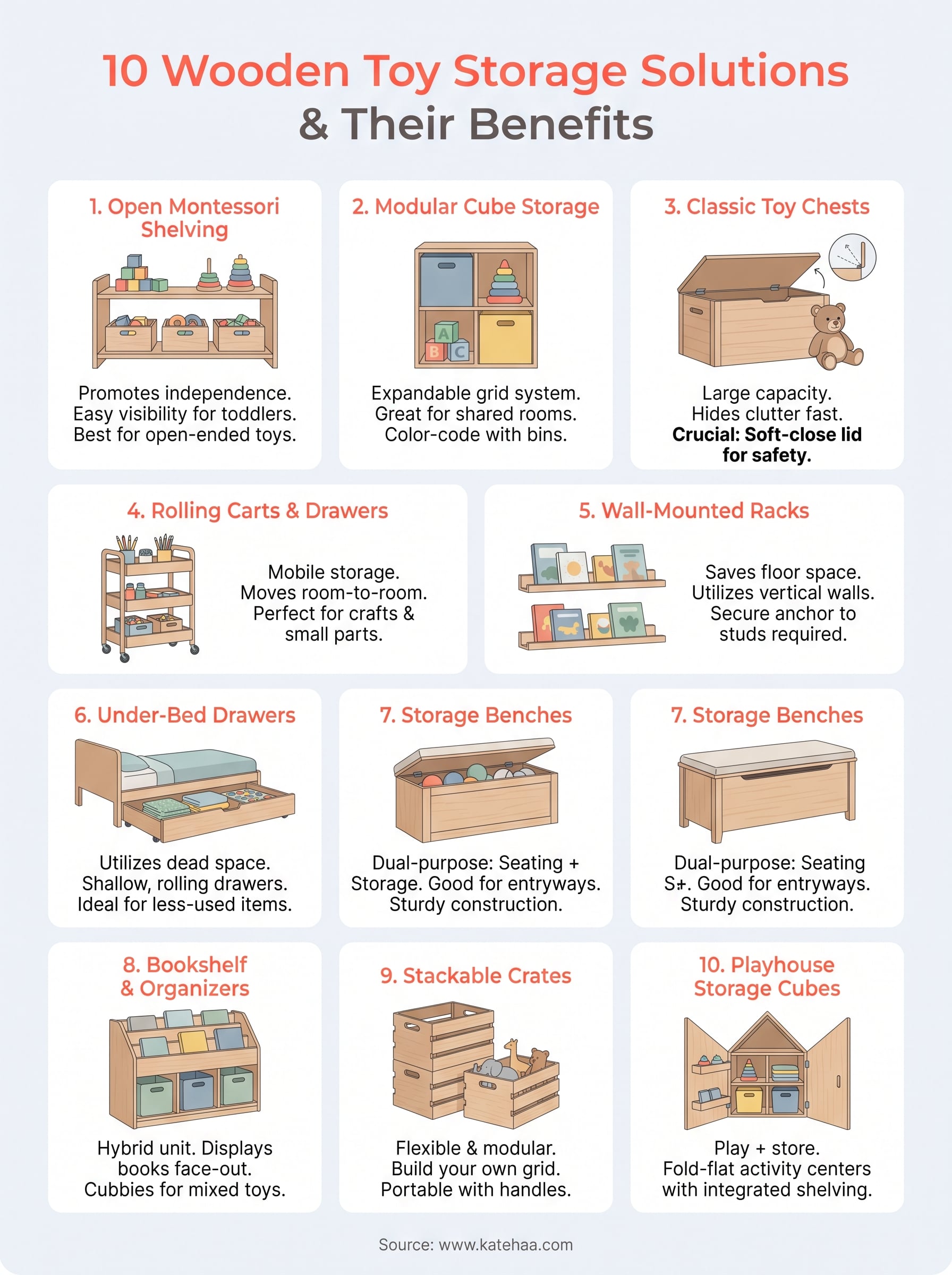
No single piece on this list solves every problem. A toddler's room needs open shelving that teaches sorting, while a shared bedroom might need a bench, a cart, and a stack of crates working together. Match the format to your child's age and the toys you actually own, not the other way around. A toy storage rack handles books and bins beautifully but does nothing for stuffed animals piling up in a corner. Drawers and chests solve that, but they hide contents from a toddler still learning independence.
Whatever you pick, prioritize solid construction over finish or trend. Wood joints, hinge quality, and drawer slides decide whether a piece lasts one year or ten. If you're ready to build a setup that actually holds up to daily use, browse our Montessori-inspired furniture and find pieces sized for your child's room and age.