

At two, your toddler wants to climb, dump, pour, sort, and test every limit of what their body can do. Most toy aisles are full of flashing lights and battery-powered gadgets that do the thinking for them. Finding real montessori toys for 2 year olds means looking for open-ended pieces that build coordination, concentration, and independence instead of just entertaining for five minutes.
The short answer: the best options are simple, natural materials that let a child repeat an action until they master it, things like climbing arches, wooden puzzles, practical life tools, and stacking sets sized for small hands. These hold up better than plastic toys with a single function, and they grow with your child rather than getting outgrown in a month. Whether you're shopping for montessori toys for 3 year olds or a two-year-old just starting to climb and build, the same principles apply.
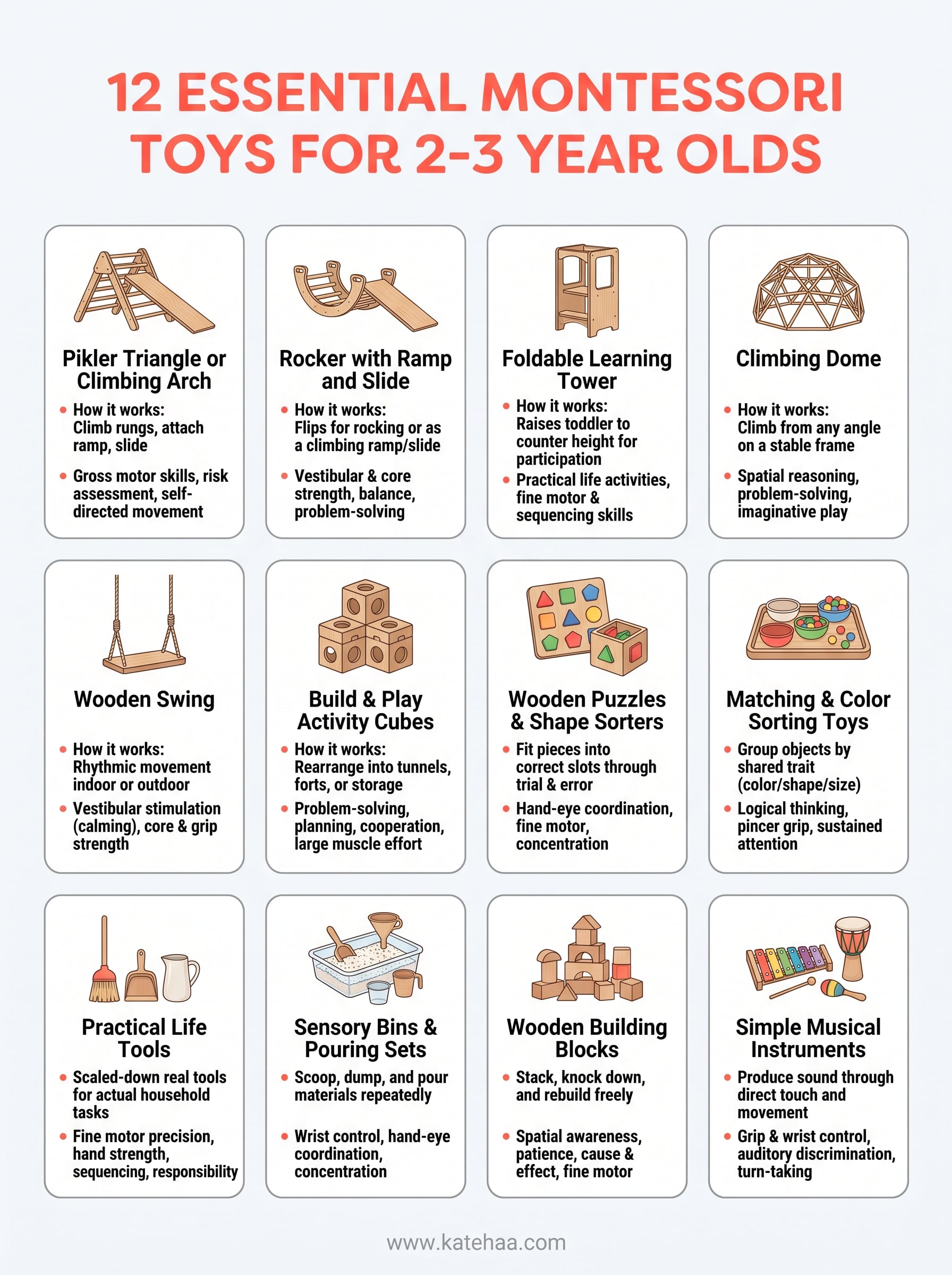
Below, we've pulled together 12 picks worth considering, from indoor climbing structures to fine motor activities, based on what actually gets used daily in Montessori homes rather than what looks good sitting on a shelf.
1. Pikler triangle or climbing arch
A Pikler triangle is a wooden climbing frame shaped like an A-frame ladder, and it's usually the first piece people picture when they think of best montessori toys for 2 year olds. Named after Hungarian pediatrician Emmi Pikler, the design gives toddlers a safe structure to climb, hang from, and use as a den, tunnel, or puppet theater once they're bored of climbing it. Unlike a plastic playset, a well-made triangle folds flat for storage and holds its shape for years, which matters if you're buying for a toddler who will outgrow a size but not the need to move.

How it works
Because the rungs are spaced for small hands and feet, a two-year-old can climb up and down without adult support once they've practiced a few times. Many versions pair with a ramp, slide, or climbing arch attachment, letting your child chain movements together instead of repeating the same motion. Some brands, including KateHaa's own climbing arches, use curved birch plywood that flexes slightly and rocks, adding a balance challenge that flat ladders don't offer. The triangle stays on the floor rather than against a wall, so kids approach it from any side and invent their own routes.
Developmental benefits
Climbing at this age isn't just physical release, it's how toddlers build gross motor skills and figure out where their body ends and the world begins. Repeated attempts at the same climb teach risk assessment in a contained way: your child learns to judge a rung's height before committing weight to it, a skill that transfers to playgrounds and stairs. This kind of self-directed, repeatable movement is exactly what separates a Montessori toy from a toy that just keeps a child occupied.
A Pikler triangle works because it lets a toddler fail safely, over and over, until climbing becomes automatic.
Toddlers also gain confidence from mastering something without being told how, which is a core Montessori principle: the adult sets up the environment, then steps back.
What to look for when buying
Quality varies enormously between brands, and a wobbly frame undoes the safety benefit entirely. Before buying, check these details:
- Wood type and finish: solid birch or beech holds up better than pine plywood, and finishes should be non-toxic and child-safe
- Weight capacity: look for at least 50 kg (110 lbs) so the frame lasts through multiple growth spurts or siblings
- Rung spacing: narrow enough that a toddler can't slip through, wide enough for a secure foothold
- Folding mechanism: a triangle that folds flat saves space in smaller apartments
- Certifications: EN 71 (Europe) or ASTM (US) compliance signals independent safety testing
- Add-on compatibility: ramps, slides, and arches that attach later let the structure grow with your child
Expect to pay somewhere between €150 and €300 for a well-built triangle with accessories, which sounds steep until you compare it to the cost of replacing cheaper plastic climbers every year or two.
2. Rocker with ramp and slide
A rocker with a ramp and slide is a curved wooden piece that flips or transforms between several play modes, usually a rocking boat on one side and an inclined ramp or slide on the other. It's smaller and more affordable than a full climbing arch, which makes it a good entry point if you're testing whether your toddler takes to open-ended climbing gear at all. Many families pair a rocker with a Pikler triangle later, since the two pieces combine to form ramps, bridges, and obstacle courses that keep changing as your child's skills improve.
How it works
Flip the rocker one way and it becomes a gentle rocking boat for balance play; flip it the other and it turns into a ramp or slide for climbing practice. Some designs, including versions with a reversible slide surface, let your two-year-old crawl up the textured side and slide down the smooth side without any reconfiguration. Because the piece is lightweight compared to a full frame, toddlers can move it themselves, which matters for independent play since they're not waiting on an adult to set things up.
Developmental benefits
Rocking motion builds vestibular and core strength in a way that static furniture never does, teaching a toddler to adjust their weight constantly to stay balanced. The switch between rocking and sliding also introduces basic problem-solving: figuring out how to flip the piece safely, how to climb the incline without sliding backward, and how to control speed on the way down.
A rocker teaches balance the way training wheels teach steering, through constant small corrections a child barely notices they're making.
Because the toy does double duty, it also holds a toddler's interest longer than single-function equipment.
What to look for when buying
Look for a rocker with a non-slip surface on the incline side and rounded edges throughout, since toddlers will inevitably tumble off at some point. Check the weight limit, ideally 50 kg or more, and confirm the wood is a solid hardwood rather than a thin laminate that flexes under repeated use. Expect prices between €250 and €500 depending on the product's size, less than a full climbing set but still built to last past toddlerhood.
3. Foldable learning tower
A learning tower is a wooden stand that raises a toddler to countertop height, with safety rails on all sides so they can stand at the kitchen counter or bathroom sink without you holding them up. Unlike a step stool, the enclosed platform means a two-year-old can lean, reach, and shift their weight without tipping over, which is why so many parents searching for montessori toys for 2-3 year olds end up adding one to the kitchen rather than the toy room. KateHaa's foldable versions come in several colors and collapse flat against a wall, so the tower doesn't have to live in the middle of the kitchen all day.
How it works
Standing your child on the platform brings their hands level with the counter, so they can stir batter, wash vegetables, or hand you ingredients as you cook. The rails on three or four sides keep a wobbly toddler contained even when they're reaching or turning around, and adjustable steps mean the platform height grows with your child instead of needing replacement. Folding models hinge flat in seconds, which matters if your kitchen doubles as the only floor space in the house.
Developmental benefits
Standing at adult height turns chores into practical life activities, letting your toddler practice pouring, mixing, and cleaning up alongside you rather than watching from the floor. This kind of participation builds fine motor control and sequencing skills, since real tasks like cracking an egg require more precision than most toys demand.
A learning tower works because it invites a toddler into real family life instead of keeping them separate from it.
Toddlers also pick up language and concepts naturally this way, hearing words like "pour," "stir," and "careful" attached to actions they're doing themselves.
What to look for when buying
Check for a wide base so the tower can't tip when a toddler leans over the counter, and confirm the platform has enough depth for small feet to turn around safely. Adjustable height settings extend the tower's usefulness well past age three, and a folding hinge saves floor space between uses. Budget €100 to €200 for a solid wood tower with a smooth, splinter-free finish.
4. Climbing dome
A climbing dome is a geodesic wooden frame built from interlocking triangles or hexagons, giving a toddler a three-dimensional structure to scale from any angle. Unlike a flat ladder or triangle, a dome has no single "correct" way up, which suits a two-year-old who wants to test different holds and routes on the same piece of equipment. KateHaa's honeycomb-shaped dome, recognized with the German Design Award 2025, is a good example of how this shape can be both sturdy and visually at home in a living room rather than looking like playground equipment dragged indoors.

How it works
Built from short wooden struts joined at multiple points, a dome distributes a child's weight across the whole frame rather than a single rung, which is part of why it feels so stable under an active climber. Toddlers grip the intersections rather than flat bars, building a different hand and foot pattern than they'd use on a triangle or ladder. Because the structure is round, several children can climb at once from different sides without getting in each other's way, which makes a dome a solid pick for siblings or playdates.
Developmental benefits
Climbing a dome demands constant spatial reasoning, since a toddler has to plan a route using irregular hand and foot holds rather than evenly spaced rungs. This variability builds problem-solving skills faster than a simple ladder does, because no two climbs up the same dome look identical.
A dome teaches a toddler to think while climbing, not just repeat the same motion until it's memorized.
The shape also encourages imaginative play once climbing gets easy, turning into a fort, a cave, or a drying rack for blankets on a rainy afternoon.
What to look for when buying
Before buying a dome, check:
- Strut spacing: tight enough that a toddler's head or arm can't get stuck
- Joint hardware: metal connectors should sit flush and be checked periodically for looseness
- Base diameter: wider bases resist tipping when several kids climb together
- Certification: EN 71 compliance for the European market
Expect to pay €300 to €400 depending on size and wood quality.
5. Wooden swing for indoor or outdoor play
A wooden swing, whether it's a disc seat, a tree swing, or a padded baby swing, gives a toddler the kind of rhythmic movement that a climbing frame can't offer. Hung from a sturdy tree branch, a ceiling beam, or a dedicated swing frame, these swings work indoors on rainy days and outdoors in the garden without needing a full playground setup. For families searching for montessori toys for two year olds that don't take up floor space, a swing is one of the few pieces you can install and forget about, since it needs no batteries and almost no maintenance beyond checking the rope.
How it works
Rope or chain attaches the seat to a fixed anchor point, and your toddler climbs on, pushes off with their feet, or gets a gentle push from you to start moving. A disc swing lets a child sit, kneel, or stand depending on their confidence, while a baby swing with a full harness suits younger toddlers who still need extra support around the hips. Because the motion is self-directed once a child learns to pump their legs, a swing becomes another piece of independent play equipment rather than something requiring constant adult involvement.
Developmental benefits
Swinging stimulates the same vestibular system that climbing does, but through continuous, predictable motion rather than the stop-start effort of scaling a frame. This steady rhythm has a calming effect on many toddlers, which is why swings show up so often in sensory-friendly play spaces and quiet corners of a classroom.
A swing calms a toddler's nervous system the same way rocking a baby does, just at a bigger scale.
Building the strength to pump legs and hold on also develops core and grip strength that carries over directly into climbing skills elsewhere.
What to look for when buying
Check the rope or chain's weight rating before buying, and make sure the seat has rounded edges with no exposed hardware a toddler could catch a finger on. Look for adjustable rope length so the swing height changes as your child grows, and confirm any ceiling or branch mount can bear dynamic load, not just static weight. Prices run from €77 for a simple disc swing to €119 for a padded baby swing with a full frame, shipping included.
6. Build and play activity cubes
A build and play activity cube is a modular wooden set of panels, ramps, and connectors that a toddler can rearrange into ball runs, small forts, or seating without any single fixed shape. KateHaa's version works as both storage cubes and a play structure, so the same pieces that hold toy bins on a Tuesday become a tunnel or a low table by the weekend. For parents comparing must have montessori toys, this one earns its spot by doing the job of several separate toys at once, which matters if space or budget is tight.
How it works
Each cube or panel connects to the next through slots, pegs, or magnets, letting a two-year-old build a simple wall today and a more complex maze once their coordination improves. Because the pieces are lightweight enough for a toddler to lift but sturdy enough to sit or climb on, the set doubles as furniture between building sessions. Sets aimed at montessori toys for 2-3 year olds usually include a ramp piece too, so a rolled ball or car becomes part of the same structure.
Developmental benefits
Rearranging heavy panels builds real problem-solving and planning skills, since a toddler has to figure out which piece supports weight before stacking another on top. Carrying and positioning cubes also strengthens the same large muscle groups climbing toys target, just through a different kind of effort.
Activity cubes teach a toddler that the same set of parts can become ten different things, which is the seed of creative thinking.
Sharing a build with a sibling or friend adds early lessons in cooperation and turn-taking that fixed playsets rarely require.
What to look for when buying
Look for rounded corners, a stable connection method that won't collapse under a climbing toddler, and panels light enough for small arms to move independently. Confirm the wood finish is non-toxic and the set carries EN 71 or ASTM certification. Prices typically range from €150 to €300 depending on the number of pieces included.
7. Wooden puzzles and shape sorters
A wooden puzzle or shape sorter gives a toddler a clear, single problem to solve: fit this piece into that slot. Chunky knob puzzles, layered geometric puzzles, and classic shape-sorting boxes all belong in the same category, and they're often the first toys people mention when asked for montessori toys for 3-4 year olds that actually teach something instead of just filling time. Unlike screens or noisy gadgets, a puzzle has one correct answer, and finding it is entirely up to the child.
How it works
Pieces have a single correct placement, so a two-year-old learns through trial and error rather than being told the answer. Knob puzzles suit younger toddlers who don't yet have the pincer grip for flat pieces, while layered puzzles and multi-piece shape sorters challenge three- and four-year-olds who need a bit more complexity. Because the toy resets itself, meaning your child dumps it out and starts again, it invites repetition without adult setup each time.
Developmental benefits
Matching a shape to its slot builds hand-eye coordination and fine motor control, since gripping a small knob or edge takes more precision than grabbing a whole toy. Puzzles also introduce early concentration and sequencing, since a child has to hold an image of the missing shape in mind while scanning the remaining pieces.
A good puzzle doesn't need instructions, because the shapes themselves tell a toddler what to do next.
This self-correcting design is a hallmark of genuine Montessori materials: the toy, not the parent, tells the child whether they've succeeded.
What to look for when buying
Before buying, check these details:
- Piece size: large enough to avoid choking hazards for toddlers under three
- Wood quality: smooth edges and a sealed, non-toxic finish
- Difficulty range: a few puzzles at slightly different levels keep pace with fast-developing skills
- Storage: a tray or frame keeps pieces from scattering across the floor
Expect to pay €15 to €40 per puzzle, with sets or bundles offering better value than single pieces.
8. Matching and color sorting toys
Matching and color sorting toys ask a toddler to group objects by a shared trait, whether that's color, shape, or size, using trays, bowls, or a simple sorting board. These sets are compact and inexpensive compared to climbing gear, which makes them an easy add-on for parents already building a collection of montessori toys for 2 3 year olds and looking to round out fine motor practice with something that fits on a small table. Wooden versions hold up better than plastic counters, which crack or fade after a season of daily handling.
How it works
A typical set includes loose pieces, pom-poms, wooden eggs, or colored discs, along with a tray or bowls marked to match. Your toddler picks up each piece, decides where it belongs based on color or category, and places it, repeating the process until every piece is sorted. Tongs or tweezers sometimes replace bare hands in more advanced versions, adding a grip challenge for three-year-olds who've outgrown the basic set.
Developmental benefits
Sorting by attribute is one of the earliest forms of logical thinking, and it lays groundwork for math concepts like categorizing and comparing that show up years later in school. The repeated pinching motion needed to pick up small pieces also builds the same pincer grip used for holding a pencil, which is why these toys show up so often on Montessori preschool shelves.
Sorting toys turn a simple pile of objects into a toddler's first experience with organizing the world by logic.
Working through a full tray also builds sustained attention, since the activity only feels complete once every piece has a home.
What to look for when buying
Choose pieces large enough to avoid choking risk for children under three, and check that colors are true and consistent rather than muddy dye jobs that make sorting confusing. A tray with recessed sections keeps pieces from rolling away mid-activity. Prices generally run €15 to €35 for a full wooden set.
9. Practical life tools for little helpers
Practical life tools are scaled-down, real versions of everyday household items, think a child-sized broom, a pitcher for pouring, a whisk, or a set of tongs, built for actual use rather than pretend play. This category is a favorite among parents hunting for best montessori toys for 2-3 year olds, because it takes the concept of the learning tower a step further: your toddler isn't just standing next to the work, they're doing it with tools sized for their hands. A small dustpan and brush or a real (blunt) knife for cutting soft fruit teaches more in ten minutes than most toy versions manage in a month.
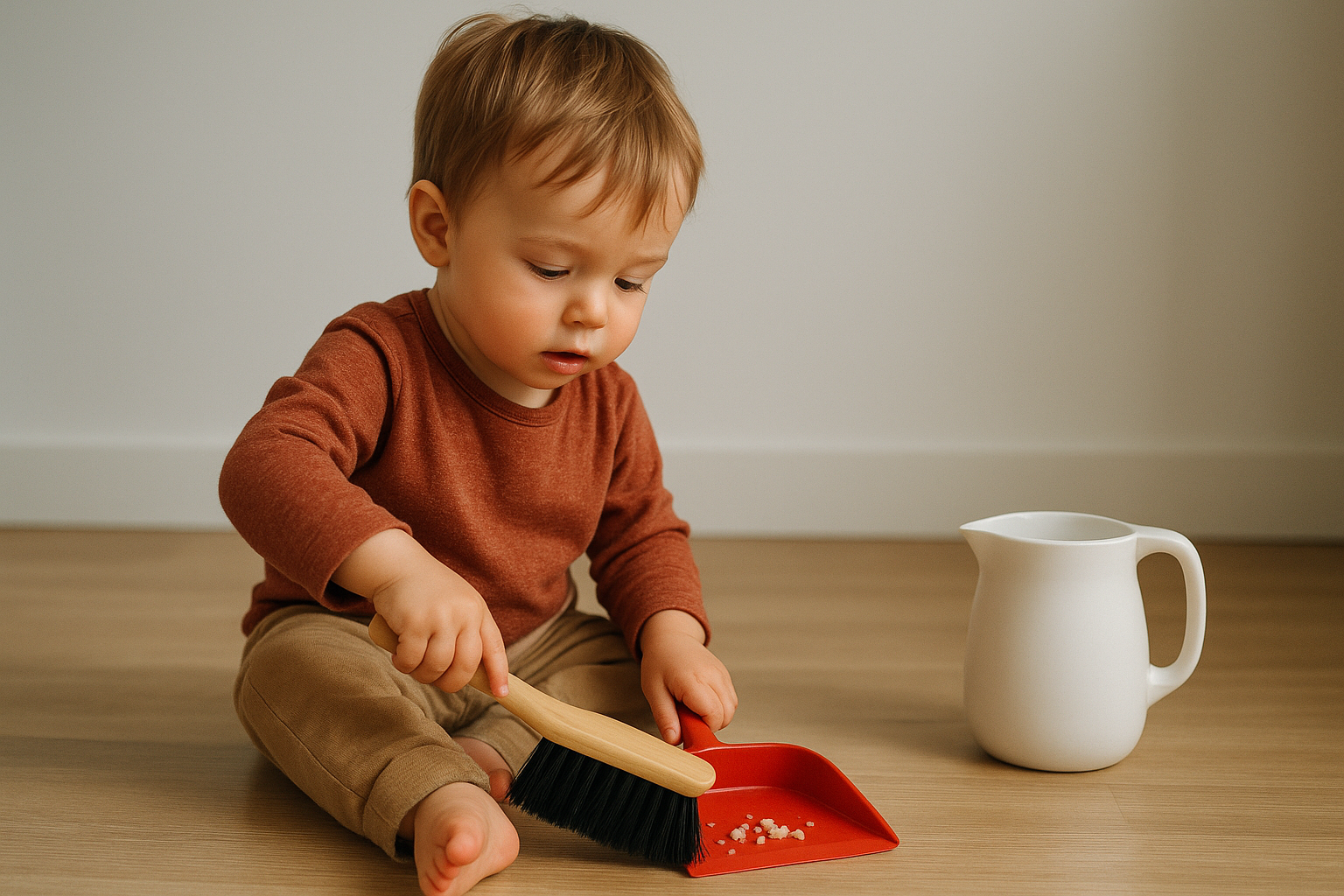
How it works
Each tool mirrors an adult version but scaled down in size and weight, so a two-year-old can grip a small broom handle or lift a child-sized pitcher without struggling. You demonstrate the task once, slowly and without talking too much, then step back and let your toddler repeat it at their own pace. Because the tools actually function, spilled water gets mopped up, cut fruit gets eaten, the activity carries real consequences that hold a child's attention far longer than a toy version ever could.
Developmental benefits
Using real tools builds fine motor precision and hand strength through tasks that matter, since sweeping a specific pile of crumbs demands more control than any generic toy. These activities also teach sequencing and responsibility, since most practical life tasks have a clear beginning, middle, and end that a toddler learns to complete independently.
Practical life tools work because a toddler cares more about a real task with a real result than about any toy pretending to be one.
Over time, this independence builds genuine self-confidence, since your child sees themselves as a contributing member of the household rather than someone being entertained.
What to look for when buying
Choose tools sized specifically for toddler hands rather than miniaturized adult versions, and check that any cutting or sharp-edged tool is genuinely safe for unsupervised toddler use. Wooden handles outlast plastic, and a small set typically costs €10 to €30 per item.
10. Sensory bins and pouring sets
A sensory bin is simply a container filled with rice, dried beans, water, or sand, paired with scoops, funnels, and small cups for pouring and transferring. Pouring sets take the same idea further, giving a toddler a pitcher and several small glasses to practice moving liquid from one container to another without spilling. Parents building out montessori toys for 3 year olds often add a sensory bin to rotate alongside puzzles and sorting trays, since it satisfies a different urge, the need to dump, scoop, and refill that most two- and three-year-olds seem to have on repeat.
How it works
Set the bin on a low table or the floor with a tray underneath to catch spills, then hand your toddler a scoop or cup and let them fill, dump, and refill on their own. Pouring sets work best with water tinted slightly with food coloring, so a child can see exactly how much liquid transferred and how much missed the cup. Because there's no fixed outcome, a filled container is just as valid an ending as an empty one, the activity resets itself every time your toddler wants to start over.
Developmental benefits
Scooping and pouring refine wrist control and hand-eye coordination in ways that flat toys can't, since liquid and loose grain shift unpredictably and demand constant small adjustments. This kind of open-ended, repeatable practice is also where concentration develops fastest, a toddler who pours water back and forth for fifteen minutes straight is doing focused work, not just killing time.
A sensory bin doesn't need a right answer, it just needs to hold a toddler's attention long enough for real skill to build underneath the mess.
What to look for when buying
Choose food-grade, non-toxic fillers if your toddler still mouths objects, and pick wooden or stainless-steel scoops over brittle plastic ones. A tray with raised edges contains spills and makes cleanup manageable. Basic sets run €10 to €25, with dedicated wooden pouring sets closer to €20 to €35.
11. Wooden building blocks and stacking toys
Wooden blocks are the oldest toy on this list and still one of the most effective, a simple set of cubes, arches, cylinders, and rectangles that a toddler stacks, knocks down, and rebuilds without any fixed instructions. Stacking rings and nesting cups belong in the same family, giving younger two-year-olds a smaller-scale version of the same skill before they graduate to full block sets. Anyone comparing the best toys for 2 year olds montessori style shopping tends to land on blocks eventually, since they're inexpensive, endlessly reusable, and rarely get boxed up in the back of a closet like flashier toys do.
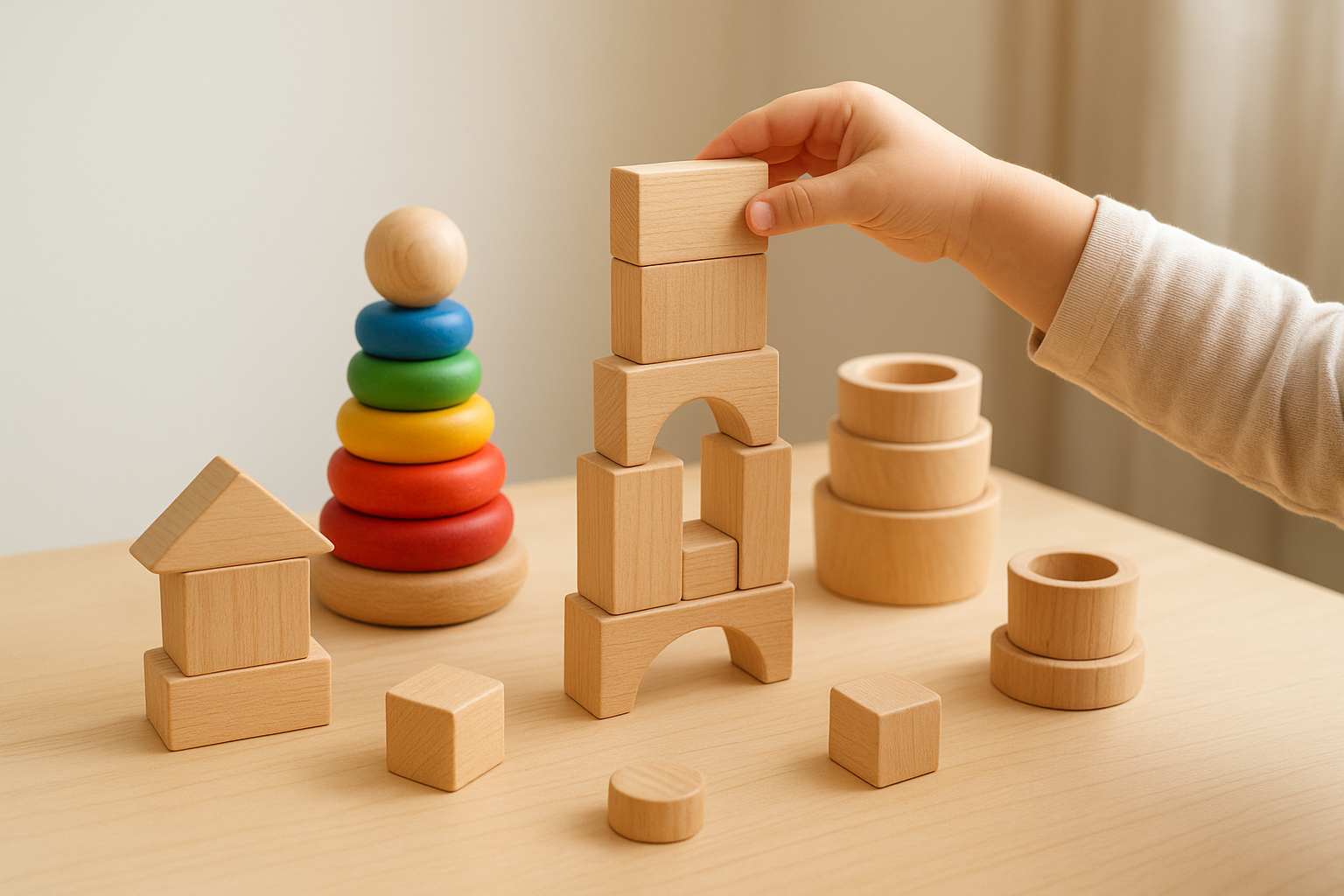
How it works
Unpainted or lightly finished wood pieces come in a range of shapes, and a toddler starts by simply stacking two or three before moving on to towers, bridges, and enclosures as their balance improves. Nesting cups and stacking rings work the same way at a smaller scale, teaching size discrimination as your child figures out which piece fits inside or on top of the next. Because there's no assembly manual, every building session looks a little different, which keeps the same set of blocks interesting for years rather than weeks.
Developmental benefits
Balancing one block on another demands real spatial awareness and patience, since a tower that topples teaches a toddler to adjust weight distribution on the next attempt. This trial-and-error process also builds early math thinking, as children start noticing which shapes stack cleanly and which roll away.
Blocks teach a toddler more through collapse than through success, since every fallen tower is a lesson in cause and effect.
Stacking also strengthens the same fine motor control that shape sorters and puzzles target, just through a taller, more physical challenge.
What to look for when buying
Choose solid hardwood over painted MDF for durability, and check that edges are sanded smooth with no splinters. A storage basket or crate keeps a full set organized between sessions. Basic sets typically cost €25 to €60, with larger architectural block sets running closer to €80.
12. Simple musical instruments
A basic set of wooden percussion instruments, think a xylophone, hand drum, shaker, or bells, gives a toddler a direct line between action and sound. Nothing about these instruments depends on batteries or pre-programmed songs, so every note comes from your child's own movement. Families rounding out their collection of montessori toys for 2 3 year olds often add music last, once climbing and sorting toys are covered, but it deserves a spot from the start since sound play works a different set of skills entirely.
How it works
Each instrument responds instantly to touch, striking a xylophone bar, shaking a rattle, or tapping a drumhead produces an immediate, audible result. A toddler experiments freely, hitting harder or softer, faster or slower, and hears the difference right away without anyone correcting them. Because there's no wrong way to play, a two-year-old builds confidence simply by making noise on purpose instead of by accident.
Developmental benefits
Handling mallets and shakers strengthens grip and wrist control, the same fine motor foundation that supports writing later on. Listening for pitch and rhythm also sharpens auditory discrimination, teaching a toddler to notice small differences in sound the way puzzles teach them to notice small differences in shape.
A toddler banging a drum isn't making noise for its own sake, they're learning that their own actions control the world around them.
Playing alongside a sibling or parent adds early lessons in turn-taking and rhythm matching, both of which carry over into group activities well beyond toddlerhood.
What to look for when buying
Choose instruments built from solid wood rather than thin plastic, since plastic mallets and drumheads wear out fast under enthusiastic toddler hands. Confirm any small parts, like shaker beads or bell clappers, are sealed inside and can't come loose. A basic wooden set typically runs €20 to €50, and a simple bundle of two or three instruments covers most of what a toddler needs for years of open-ended sound play.
Bringing Montessori play into everyday life
You don't need all twelve of these at once. Start with one piece that matches what your toddler already gravitates toward, whether that's climbing the couch or dumping every basket in the house, and build from there. A climbing arch handles the physical energy, a few wooden puzzles cover fine motor work, and a learning tower pulls your child into daily chores instead of keeping them on the sidelines. The goal isn't a perfectly styled shelf, it's giving your two- or three-year-old real, repeatable ways to practice the skills they're already trying to master on their own.
Good Montessori toys earn their keep by getting used every day, not by sitting untouched after the first week. If you're ready to build out a setup that actually lasts through toddlerhood and beyond, browse KateHaa's full collection of Montessori toys and furniture and find the pieces your family will use for years.