

Walk into any toy store and you'll find shelves packed with flashing lights, batteries, and plastic parts that break in a week. None of that helps a child actually learn. Montessori toys work differently: they're built from natural materials, designed for one clear purpose, and sized so a child can succeed on their own without an adult stepping in every five minutes. That independence is the whole point.
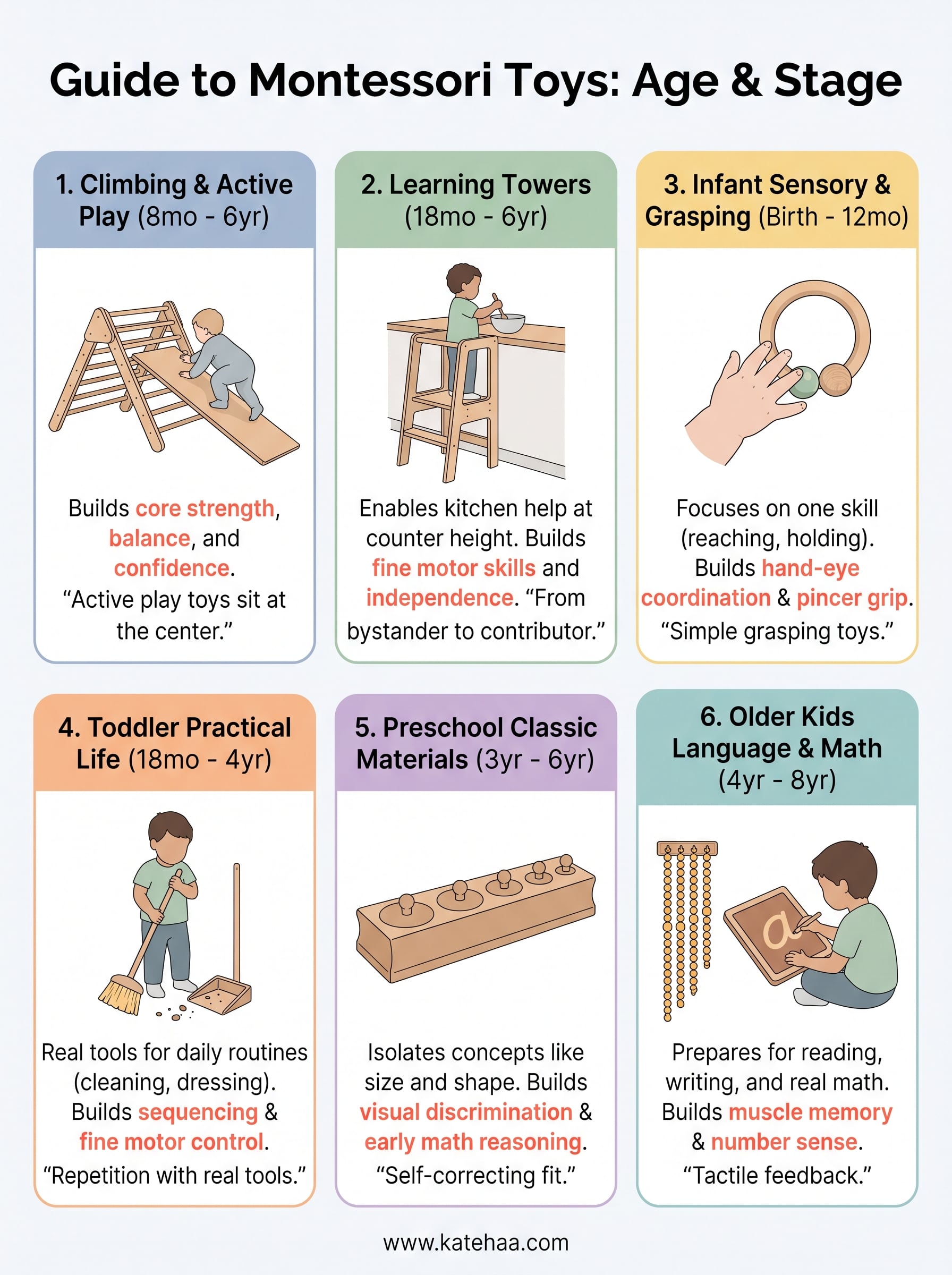
If you're trying to figure out which montessori education toys actually fit your child's age and stage, you're in the right place. A wobbly 12 month old needs something completely different from a curious 4 year old testing balance and problem-solving skills. This guide breaks down real montessori toys by age, from first grasping toys to climbing structures for preschoolers, so you're not guessing at what will hold their attention past week one.
Below, we've organized picks by developmental stage, covering everything from classic montessori toys like simple wooden puzzles to bigger investments like climbing arches and learning towers. Whether you're shopping for a birthday, a holiday, or just replacing the plastic clutter at home, you'll find something that matches where your child actually is right now.
1. Climbing arches, Pikler triangles, and active play toys
A Pikler triangle is a folding wooden climbing frame, usually paired with a ramp or rocker board, that lets a child practice balance, grip, and risk assessment without a parent hovering underneath. This category also covers climbing domes and rockers with slides, which give older toddlers a bigger physical challenge once they've mastered the basics. Active play toys like these sit at the center of most Montessori-inspired playrooms because gross motor development is treated as seriously as academic skills in this philosophy.

Age range and stage
Most triangles work from around 8 months, once a baby starts pulling up to stand, through age 5 or 6. A smaller frame suits montessori toys for 1 year old shoppers looking for a first climbing structure, while taller domes and multi-piece sets are better suited to preschoolers who've outgrown basic pull-up and cruise movements.
Skills it builds
Children using climbing arches build core strength, spatial awareness, and confidence in their own physical limits. Repeated practice teaches them to judge height and distance on their own, which is a skill no flashcard can replace.
A child who learns to judge their own limits on a climbing arch carries that confidence into every other physical challenge they face.
What to look for when buying
Before buying, check these details against the manufacturer's specs:
- Weight capacity and certification: look for EN71 or ASTM safety testing, not just a marketing claim
- Wood type: solid birch or beech holds up to daily use better than plywood
- Foldability: a triangle that folds flat matters if floor space is tight
- Non-toxic finish: water-based, child-safe sealant only
- Modularity: arches that pair with ramps, slides, or nets extend the toy's useful years
Getting the fit right the first time saves you from buying a second, bigger structure within a year.
2. Learning towers and kitchen helper toys
A learning tower is a raised, guard-railed platform that lets a toddler stand safely at counter height and actually help with cooking instead of watching from the floor. Unlike a plain step stool, the sides keep a wobbly climber from tipping sideways while they stir, pour, or wash vegetables next to you. Foldable versions collapse flat against a wall when not in use, which matters in smaller kitchens.

Age range and stage
Most towers fit children from around 18 months, once standing and stepping up are steady, through age 5 or 6. This makes them a strong pick for montessori toys for 12 month old shoppers planning ahead, since a slightly older baby will grow into the tower within months rather than outgrowing it.
Skills it builds
Standing at counter height gives a toddler real practical life experience: measuring, pouring, and coordinating both hands on a task with a visible result.
A learning tower turns a child from a bystander in the kitchen into a genuine contributor.
That sense of contribution builds patience and fine motor control faster than most seated activities.
What to look for when buying
Before buying, compare a few practical details:
- Adjustable height: platforms that raise in steps extend use across several years
- Rail height: should reach roughly chest height on your child, not just the waist
- Stability: a wide base prevents tipping when a toddler leans over the counter
- Foldability: check if it folds flat for storage between uses
- Finish: water-based, non-toxic sealant that can handle spills and wiping down daily
3. Sensory and grasping toys for infants
Before a baby can stack a block or turn a page, they need toys that fit their tiny hands and short attention span. Grasping toys like wooden rattles, textured balls, and simple ring stackers are designed around one skill at a time: reaching, holding, or releasing. These aren't flashy, but that's the point. A newborn doesn't need stimulation from three directions at once; they need one clear object to focus on.
Age range and stage
This category covers roughly birth to 12 months, right up through the early stretch of montessori toys for 1 year old shopping lists. A three-month-old benefits from a simple rattle with contrasting colors, while a nine-month-old is ready for grasping toys that require pincer grip, like small wooden rings or textured balls sized for one hand.
Skills it builds
Early grasping toys build hand-eye coordination and the pincer grip a baby will later use for feeding and drawing. Textured surfaces also feed sensory input directly to a developing nervous system.
A baby's first job is learning to control their own hands, and the right toy makes that job possible.
What to look for when buying
- Size: large enough to avoid a choking hazard, small enough for one hand
- Material: untreated or food-grade finished wood, since everything goes in the mouth
- Weight: light enough for weak infant wrists to lift repeatedly
4. Practical life toys for toddlers
Once a toddler starts imitating everything you do, practical life toys give that energy somewhere useful to go. Think child-sized brooms, pouring sets, dressing frames with real buttons and zippers, and simple sorting trays. These aren't miniature versions of adult tools for looks; each one isolates a single skill a toddler is already trying to master, like buttoning a coat or pouring water without a flood.
Age range and stage
Most of these toys suit children from around 18 months through age 4, overlapping with the tail end of shopping for montessori toys for 12 month old gifts and stretching into early preschool. A younger toddler starts with basic pouring or scooping, while a 3 or 4 year old is ready for dressing frames and multi-step sorting tasks.
Skills it builds
Repetition with real tools builds fine motor control, sequencing, and independence in daily routines like dressing and cleaning up.
A child who learns to button their own coat at three carries that same confidence into every task that follows.
Success here comes from doing, not from being told the right answer.
What to look for when buying
- Real materials: metal buckles and glass pitchers teach cause and effect better than plastic substitutes
- Right-sized proportions: tools scaled to small hands, not shrunk-down adult versions
- Single skill focus: one task per toy avoids overwhelming a toddler
- Sturdiness: frames and trays that survive daily drops and spills
5. Classic Montessori learning materials for preschoolers
Once a child moves past pouring and buttoning, classic montessori toys like knobbed cylinder blocks, sound boxes, and geometric solids take over. These are the actual materials Maria Montessori designed a century ago, still used in montessori preschool toys collections because nothing since has replaced them. Each one isolates a single concept, size gradation, texture, or shape, so a child works through it without needing correction from an adult.
Age range and stage
This category fits children from roughly 3 to 6 years old, right in the window most parents associate with educational montessori toys. A 3 year old starts with simple knobbed puzzles, while a 5 or 6 year old is ready for multi-piece geometric cabinets and sound-matching sets.
Skills it builds
These materials build visual discrimination, size sequencing, and early math reasoning through the hands rather than through instruction.
A child who sorts by size and shape at four is already doing math, just without the worksheet.
What to look for when buying
- Authentic design: materials that match the original Montessori specifications, not a simplified knockoff
- Self-correcting fit: pieces that only fit one correct way
- Solid wood construction: withstands years of handling across siblings
6. Language, math, and fine motor toys for older kids
By age 4 or 5, a child is ready for tools that build toward reading, writing, and real math rather than just sorting and matching. Sandpaper letters, movable alphabets, bead chains, and spindle boxes fall into this category. These montessori toys for 4 year olds look simple, but each one prepares a specific skill: tracing a letter's shape before writing it, or counting physical beads before adding on paper. This is where montessori developmental toys shift from sensory exploration into the groundwork for formal academics.
Age range and stage
This category spans roughly 4 to 8 years, covering the last stretch of preschool through early elementary. A 4 year old typically starts with sandpaper letters and simple bead stairs, while a 7 or 8 year old moves into multiplication boards and more complex spelling work.
Skills it builds
Tracing letters builds the muscle memory needed for handwriting before a pencil ever enters the picture. Bead work builds real number sense, not memorized answers.
A child who counts real beads before doing worksheets understands math instead of just repeating it.
What to look for when buying
- Sequential design: materials that build on each other rather than jumping ahead
- Tactile feedback: textured letters and countable pieces, not printed images
- Durable wood: pieces handled daily need to survive years of use
- Accurate scale: bead sizes and letter shapes that match Montessori standards
Building a play space that grows with your child
No single toy carries a child from infancy to elementary school. A Pikler triangle earns its keep at 8 months and again at 4 years once you add a ramp or net. A learning tower bought for a 12 month old still gets daily use at age 5. That's the real test of montessori toys: does it grow with the child, or does it get boxed up after one birthday? Think in stages, not single purchases, and you'll spend less over time while giving your child fewer, better-used toys.
Once you know the stage your child is actually in, shopping gets simple. Skip the flashing plastic aisle and build a room around wood, purpose, and independence instead. If you're ready to see what real, furniture-grade Montessori pieces look like in solid birch, browse the full KateHaa collection and find the piece that fits where your child is right now.