

Toys pile up fast, and a floor covered in blocks and books makes it hard for kids to find anything or for you to keep the room looking calm. A good toy organizer with shelf storage fixes both problems at once: it gives every toy a visible spot and turns cleanup into something your child can actually do on their own, which is the whole idea behind Montessori-style organization.
If you're searching for the right toy storage shelf, you want something sturdy enough for daily use, open enough for toddlers to reach without help, and attractive enough to fit your living room or nursery instead of looking like a plastic bin dumped in the corner. Height, shelf depth, and material safety matter just as much as looks, especially with active kids climbing and pulling drawers.
We've picked eight standout options, from compact bookshelf-style units to larger toy organizer shelf systems built for growing toy collections. Each one balances natural materials, real durability, and a design that actually earns its place in a kid's room, so you can pick the one that fits your space and your child's age.
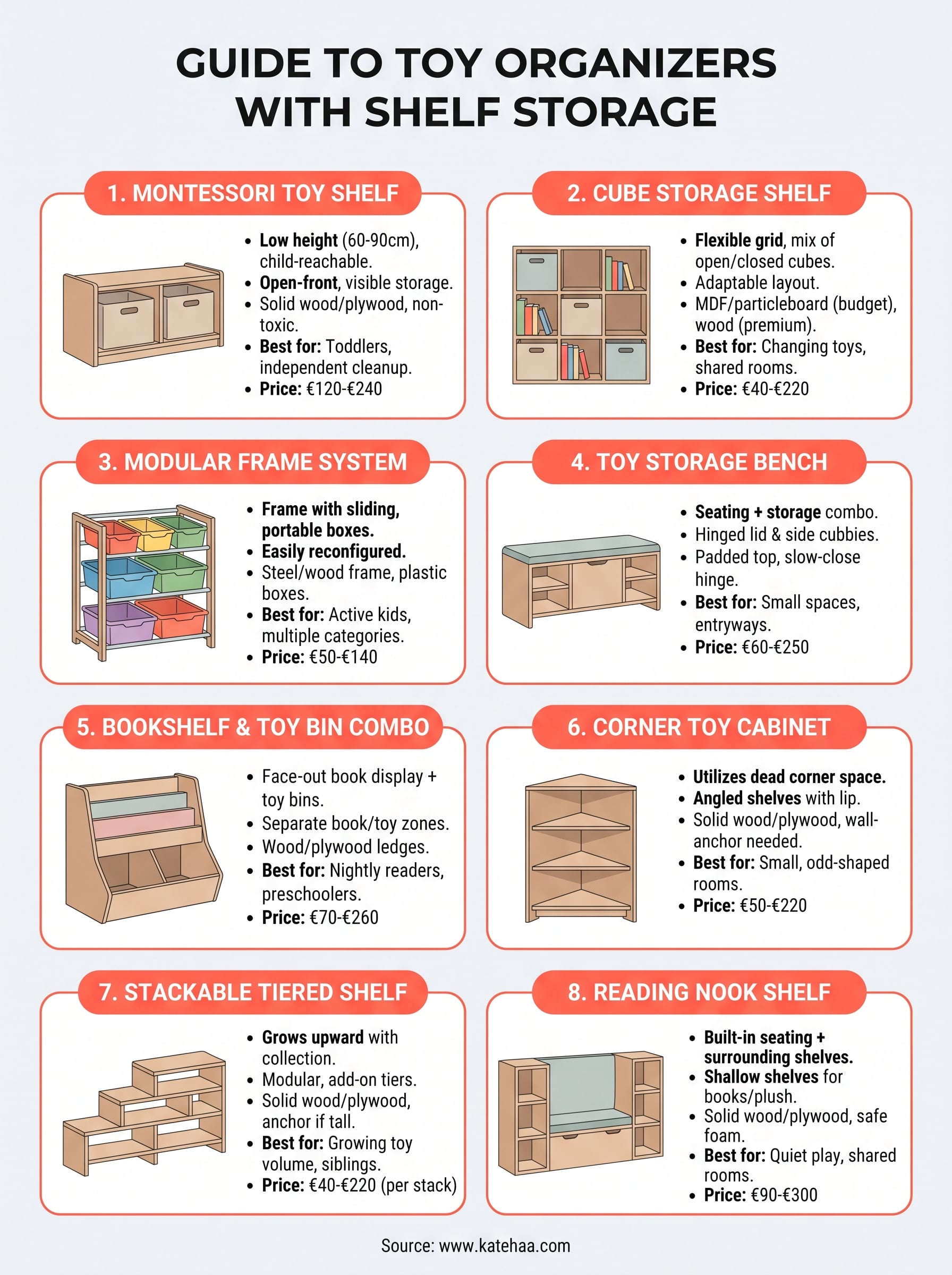
1. KateHaa Montessori toy shelf with storage bins
KateHaa's own Montessori toy shelf is the benchmark we measure every other option against, and not just because it's our product. It's built around the same open-shelf, child-height principle that runs through the whole Montessori furniture philosophy: everything visible, everything reachable, nothing locked behind a door a toddler has to ask an adult to open. The shelf pairs low, wide cubbies with matching fabric or wooden bins, so loose parts like blocks, cars, and puzzle pieces stay contained instead of sliding around an open shelf.

Key features
What sets this shelf apart from a generic cube unit is how deliberately it's sized for small hands and small rooms. The bins slide out far enough to dump and sort but stop before they tip forward, and the whole frame is low enough that a two-year-old can see every option at a glance instead of guessing what's buried on a top shelf.
- Open-front cubbies sized for standard fabric or wooden storage bins
- Low overall height (typically 60-90 cm) so toddlers can see and reach every bin
- Rounded edges and corners on all exposed surfaces
- Optional matching bins in neutral or bright color sets
- Flat-pack shipping with hardware, tools, and illustrated assembly instructions included
A shelf your toddler can actually use without asking for help is the whole point of Montessori storage.
Best for
This style suits families who want their child doing real cleanup, not supervised cleanup. Toddlers and preschoolers between about one and six years old get the most out of it, since the shelf height and bin size are scaled to that age range rather than to adult convenience. It also works well in shared playrooms where several kids need separate, clearly labeled zones for their own toys, and in smaller apartments where a low, shallow footprint matters more than sheer storage volume.
Materials & safety
Every unit is built from solid or FSC-certified plywood, finished with water-based, non-toxic paints and sealants rather than laminates or particleboard that can off-gas over time. Corners are sanded and rounded by hand, and the finished panels pass EU toy safety testing, which matters if you're comparing this against furniture-grade shelving that was never actually designed with children in mind. KateHaa ships internationally from Latvia with free shipping across Europe, and each shelf arrives disassembled with the tools you need already in the box, so setup takes an evening rather than a weekend.
Price range
Pricing sits in the mid-to-premium range for wooden kids' furniture, reflecting solid materials and furniture-grade joinery rather than particleboard and dowels. Expect the base shelf to run higher than a plastic cube organizer from a big-box store, but the trade-off is a piece that survives years of daily use, multiple children, and the occasional climbing attempt.
| Configuration | Typical price range |
|---|---|
| Shelf only, no bins | €120-€180 |
| Shelf with matching storage bins | €160-€240 |
| Custom color or size on request | Quote on inquiry |
Custom sizing and color options are available on request if the standard dimensions don't fit your room, which is worth asking about before you default to a smaller, cheaper unit that your child will outgrow in a year.
2. Cube storage shelf for versatile toy sorting
A cube storage shelf is the classic grid of open squares, usually nine or twelve compartments arranged in a low, wide frame. Each cube holds a fabric bin, a stack of board books, or loose toys sitted directly on the shelf, which makes this style one of the most flexible toy organizer shelf options for families who reorganize often as their kids grow out of one set of toys and into another.
Key features
The appeal of a cube shelf is how easily it adapts to whatever's currently taking over the playroom floor. You can mix bins and open cubes in the same frame, swap bin sizes as toys change, and rearrange the whole layout without buying new furniture.
- Grid layout with 6-16 identical square compartments
- Compatible with standard fabric bins sized around 26x26 cm
- Some cubes left open for books, puzzles, or display toys
- Often stackable or expandable with add-on units
- Lightweight enough for one adult to move and reposition
The best organizer isn't the biggest one, it's the one your kid will actually use without being asked twice.
Best for
Cube shelves work well for families with toys in constant flux, think preschoolers cycling through phases fast, or households with kids spanning a wide age range who need separate bins for different collections. Growing families that add a sibling every few years appreciate that a cube shelf can simply gain another row of bins instead of needing a whole replacement unit.
Materials & safety
Budget versions use MDF or particleboard with a laminate finish, which keeps the price low but wears faster around edges and corners than solid wood. Better units use plywood or solid pine with rounded edges and a wall-anchoring kit, since a tall, top-heavy cube shelf is a tip-over risk once a toddler starts climbing the open squares like a ladder. Check for a CPSIA or EN71 safety certification before buying, and confirm the finish is water-based rather than a solvent-heavy varnish, especially if the shelf will sit in a nursery.
Price range
Cube storage shelves are one of the more affordable entries on this list, largely because the flat-panel construction is simple to mass-produce.
| Configuration | Typical price range |
|---|---|
| 6-cube shelf, no bins | €40-€70 |
| 9- to 12-cube shelf with bins | €80-€150 |
| Premium solid wood version | €150-€220 |
Expect the cheapest units to feel noticeably lighter and less stable than the solid wood options higher up this range.
3. Modular frame system with removable toy boxes
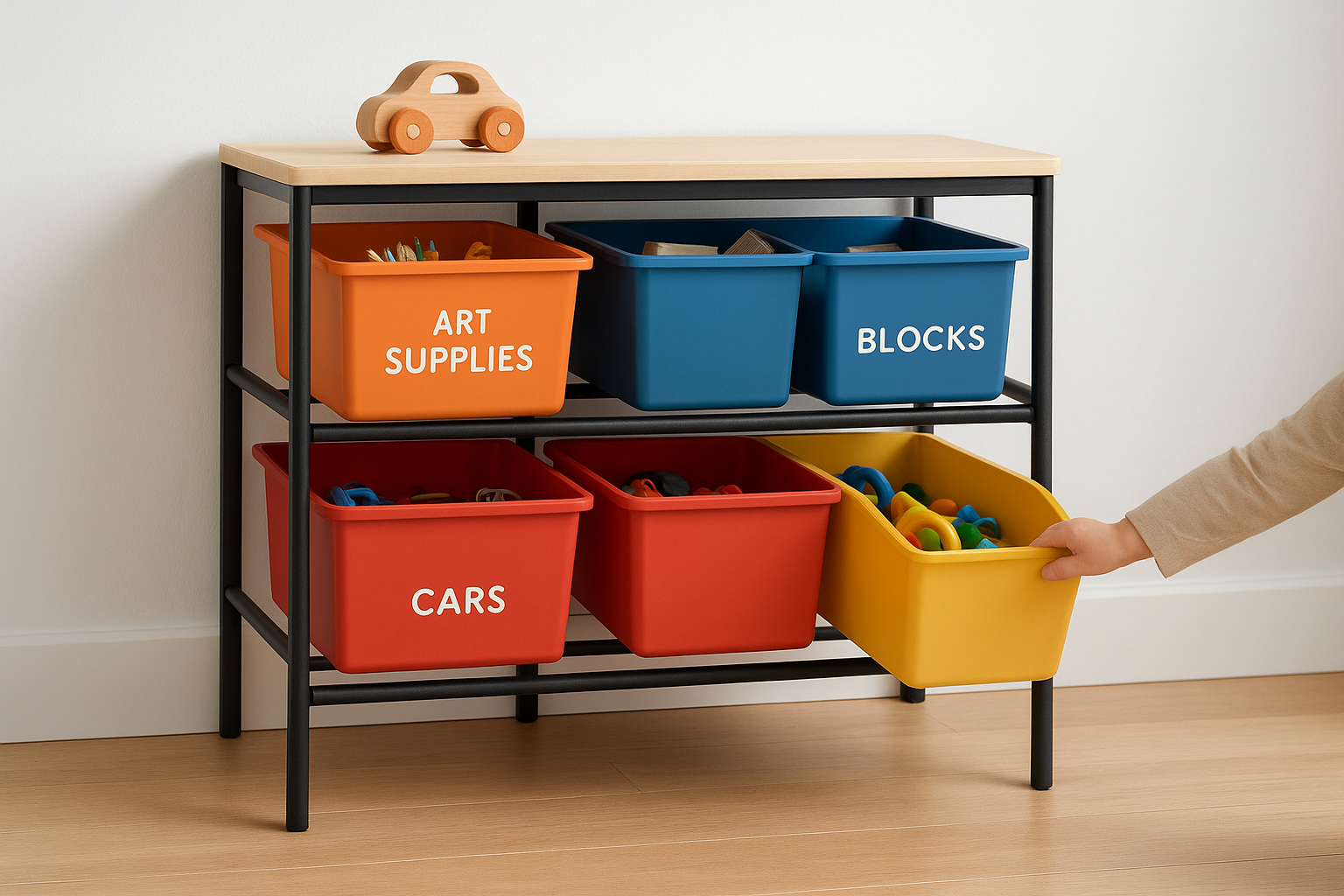
A modular frame system swaps the fixed cube grid for an open steel or wood frame that holds individual plastic or wooden boxes on rails. Each box slides out like a drawer, but without the drawer mechanism, so there's nothing to jam or break when a toddler yanks it too hard. This design shows up often in daycare settings, and it's a smart pick for anyone who wants a toy organizer with shelf flexibility but doesn't want to commit to a permanent bin layout.
Key features
Unlike a fixed cube shelf, the frame itself stays mostly empty, just rails and a skeleton structure, while the boxes do all the storage work. That separation is what makes the system so easy to reconfigure as your kid's toy collection changes shape.
- Steel or wood frame with horizontal rails spaced for standard-size boxes
- Boxes labeled or color-coded by category (art supplies, blocks, cars)
- Boxes removable for carrying toys to another room or outside
- Frame often expandable by adding extra rail sections
- No doors, hinges, or drawer slides to wear out over time
A box you can carry away is more useful than a drawer you have to unload on the floor first.
Best for
Active households with more than one child benefit most here, since each kid can grab their own labeled box instead of digging through a shared bin. It also suits families who move frequently or rearrange rooms often, because the frame breaks down faster than a solid cube shelf and the boxes double as portable totes for car rides or grandma's house.
Materials & safety
Frames come in either powder-coated steel or solid wood, and the steel versions need a wall anchor if the unit is more than knee-high, since an empty frame is lighter and tips more easily than a loaded cube shelf. Boxes are usually BPA-free plastic or untreated wood, and you should check that plastic boxes carry a food-grade or EN71 certification rather than generic recycled plastic, since kids chew on box edges more than parents expect.
Price range
This style lands in the middle of the pack price-wise, with steel frames usually cheaper than solid wood ones.
| Configuration | Typical price range |
|---|---|
| Steel frame, 6 boxes | €50-€90 |
| Wood frame, 9 boxes | €90-€140 |
| Extra box sets | €15-€25 each |
Buying a few spare boxes upfront saves you a mismatched-color headache later, since manufacturers change box colors between production runs.
4. Toy storage bench with built-in shelving
A toy storage bench does double duty as seating and storage, with a hinged or open-front lid covering a shelf compartment underneath, sometimes flanked by smaller open cubbies on either side. Families short on floor space like this style because it replaces two pieces of furniture with one, a reading spot and a toy storage shelf in the same footprint. You'll see it most often at the foot of a bed or under a window, doing quiet double duty as both seating and storage.
Key features
Benches in this category vary more than most other entries on this list, since some prioritize the lid-covered compartment and others lean on open shelving with a cushioned top. Either way, the goal is the same: a sturdy surface a child can sit on without the whole unit wobbling or the lid slamming shut on small fingers.
- Padded or hard bench top rated for a child's full body weight
- Hinged lid with a slow-close hinge or safety stay to prevent slamming
- Side cubbies or under-seat shelf for bins, books, or shoes
- Weight capacity typically listed for both sitting and toy load
- Compact footprint suited to bedrooms and entryways
A bench that doubles as storage earns its keep twice as fast as a shelf that only holds toys.
Best for
This design suits small bedrooms, shared rooms, and entryways where floor space is tight and every piece of furniture needs to earn its spot twice over. Parents who want a designated reading or dressing spot near the toy storage, rather than a bare shelf against a wall, tend to prefer this over a plain cube unit.
Materials & safety
Look for a soft-close hinge or a safety stay bar on any lidded bench, since a lid that drops on its own is one of the more common injury risks in kids' furniture. Solid wood or plywood construction holds up to daily sitting far better than particleboard, which sags under repeated weight. Confirm the bench top is rated for a child's full weight, not just light toy storage, and check for rounded seat edges and a stable base that won't tip when a kid climbs on rather than sits down.
Price range
| Configuration | Typical price range |
|---|---|
| Basic bench, open shelf | €60-€100 |
| Bench with hinged lid and side cubbies | €100-€170 |
| Solid wood, upholstered top | €170-€250 |
Upholstered tops add comfort but also add cost, so weigh that against how much seating time the bench will actually get.
5. Bookshelf and toy bin combo for books and toys
A bookshelf and toy bin combo splits the frame in two: forward-facing book ledges on top, open cubbies or bins below for toys, blocks, and stuffed animals. This layout solves a problem plain cube shelves don't address well, since spine-out books get lost on a deep shelf while a face-out ledge lets a toddler pick a title by its cover the way most preschoolers actually choose books. It's a strong pick if you're searching for a toy organizer with shelf space built specifically to keep reading material separate from loose toys instead of mixing everything into identical square cubbies.
Key features
The split design is what earns this unit its spot on the list, since it treats books and toys as genuinely different storage problems rather than forcing both into the same bin. Ledges sit at a slight lip or angle so covers stay upright without sliding flat.
- Angled or lipped ledges for face-out book display
- Lower open cubbies or bins for toys and stuffed animals
- Combined height usually 90-120 cm to reach both zones
- Ledge depth shallow enough to prevent book stacking and hiding
- Optional bin inserts for the lower toy section
A book a kid can see is a book a kid will actually pick up.
Best for
This combo suits families who read nightly and want that habit reinforced by furniture, not just a plastic bin shoved under a bed. It works especially well for kids around two to seven, the age range where cover recognition still matters more than reading titles, and for playrooms where books and toys need visually distinct homes so cleanup sorts itself.
Materials & safety
Solid wood or plywood ledges hold up better than laminate, which chips at the lip where books slide in and out dozens of times a day. Check that the unit is anchored to the wall if it's taller than a meter, since top-heavy bookshelf combos are a known tip-over hazard once a child starts using the ledges as footholds, a risk the Consumer Product Safety Commission has flagged repeatedly for furniture in this height range.
Price range
| Configuration | Typical price range |
|---|---|
| Basic ledge and bin combo | €70-€120 |
| Larger unit with multiple ledges | €120-€190 |
| Solid wood, premium finish | €190-€260 |
Budget for wall anchors separately if they're not already included, since most combos ship without them.
6. Corner toy cabinet with angled display shelves
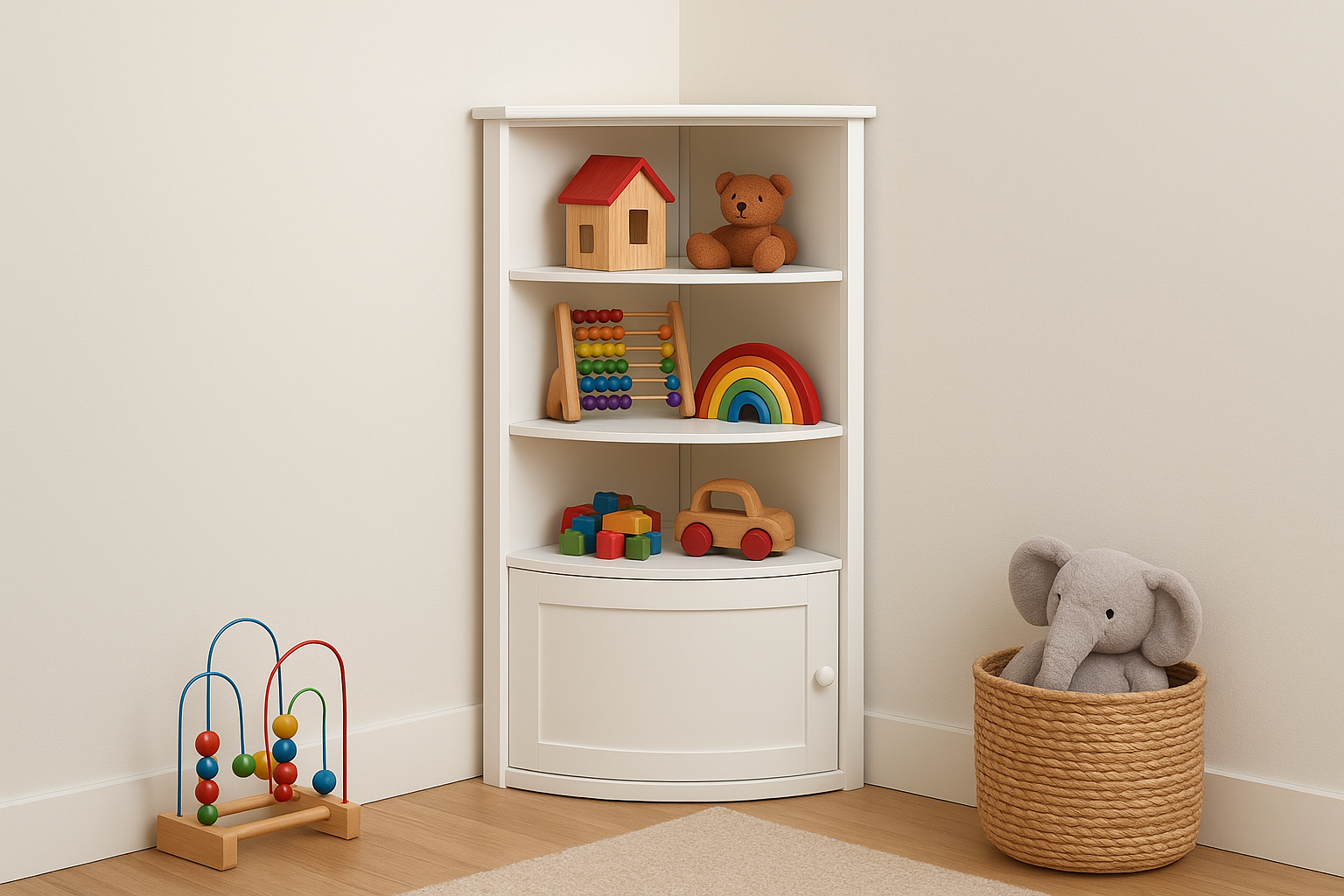
Corner units solve a problem most rectangular shelves ignore: the dead space in the corner of a bedroom or playroom that's too awkward for a bed or dresser but too big to waste. A corner toy cabinet fits into that triangle with angled shelves that follow the wall lines, giving you a toy organizer with shelf storage that adds capacity without eating into your usable floor space. It's a niche pick compared to the cube and bookshelf styles above, but for a small or oddly shaped room, it's often the only style that actually fits.
Key features
Manufacturers cut these shelves at a triangular or pie-slice angle so the unit sits flush against two walls at once, which is a different build than any square shelf on this list. Some versions add a slight lip or divider on each shelf tier to keep toys from sliding toward the back where a small hand can't reach them.
- Triangular or pie-slice shelf profile built for 90-degree corners
- Three to five open tiers, each angled slightly forward
- Shallow depth compared to rectangular units, usually 25-35 cm per side
- Optional bottom cabinet with a door for less-used items
- Wall-mounting brackets included for tip-over prevention
A corner unit turns wasted space into working storage without shrinking the room.
Best for
This style suits smaller bedrooms, apartments, or shared kids' rooms where every square foot of floor is already claimed by a bed, desk, or play mat. Parents furnishing a nursery around a fixed layout, rather than an open playroom, tend to reach for a corner cabinet because it slots in without forcing a rearrange of everything else.
Materials & safety
Because corner units often sit taller and narrower than a standard cube shelf, wall anchoring matters even more here. Solid wood or plywood construction resists the wobble that thinner MDF panels develop over time, especially at the joints where two angled sides meet. Confirm the shelf tiers have a lip or raised edge, since angled shelves without one let smaller toys roll off the front.
Price range
| Configuration | Typical price range |
|---|---|
| Basic 3-tier corner shelf | €50-€90 |
| 4- to 5-tier with bottom cabinet | €100-€160 |
| Solid wood, custom-fit sizing | €160-€220 |
Custom-fit sizing costs more but pays off in rooms with non-standard corner angles or low ceilings.
7. Stackable tiered shelf for growing toy collections
A stackable tiered shelf starts as a single low unit and grows upward as your child does, adding a new tier whenever the toy collection outgrows the current one. Instead of buying a bigger toy storage shelf and hauling the old one to storage, you snap or bolt another tier on top of the last. Families who've watched a toddler's toy pile double in six months tend to appreciate a system that scales without a full furniture swap.
Key features
Each tier locks onto the one below it with pegs, brackets, or a simple interlocking edge, so the whole stack behaves like one solid piece once assembled rather than a wobbly pile of boxes. Manufacturers usually cap the stack at three or four tiers for stability, since going higher shifts too much weight above a toddler's reach.
- Individual tiers that connect via pegs, brackets, or interlocking grooves
- Each tier usable alone or stacked with others as the collection grows
- Open-front design on every tier for full visibility
- Maximum recommended stack height usually three to four tiers
- Add-on tiers sold separately from the base unit
Furniture that grows with your kid beats furniture you have to replace every year.
Best for
This style suits parents who'd rather add a tier than shop for a whole new shelf, particularly during the toddler-to-preschool stretch when toy volume changes fastest. It also works for families expecting a second child soon, since the stack can expand right alongside a growing sibling group instead of forcing a separate purchase for each kid.
Materials & safety
Solid wood or plywood tiers connect more securely than the light MDF versions sold under the same name, and a loose interlock is the main failure point to check before buying. Confirm the base tier is weighted or wide enough to anchor the stack, since a top-heavy tower on a narrow base tips more easily than a single-height shelf. As with any tall furniture piece, secure the finished stack to the wall once you're past two tiers, a step the CPSC recommends for any freestanding unit a child could climb.
Price range
| Configuration | Typical price range |
|---|---|
| Base tier only | €40-€70 |
| Base plus two add-on tiers | €90-€150 |
| Full four-tier solid wood stack | €150-€220 |
Buying tiers gradually spreads the cost out, which makes this one of the more budget-friendly ways to scale storage over several years.
8. Reading nook shelf with toy and plush storage
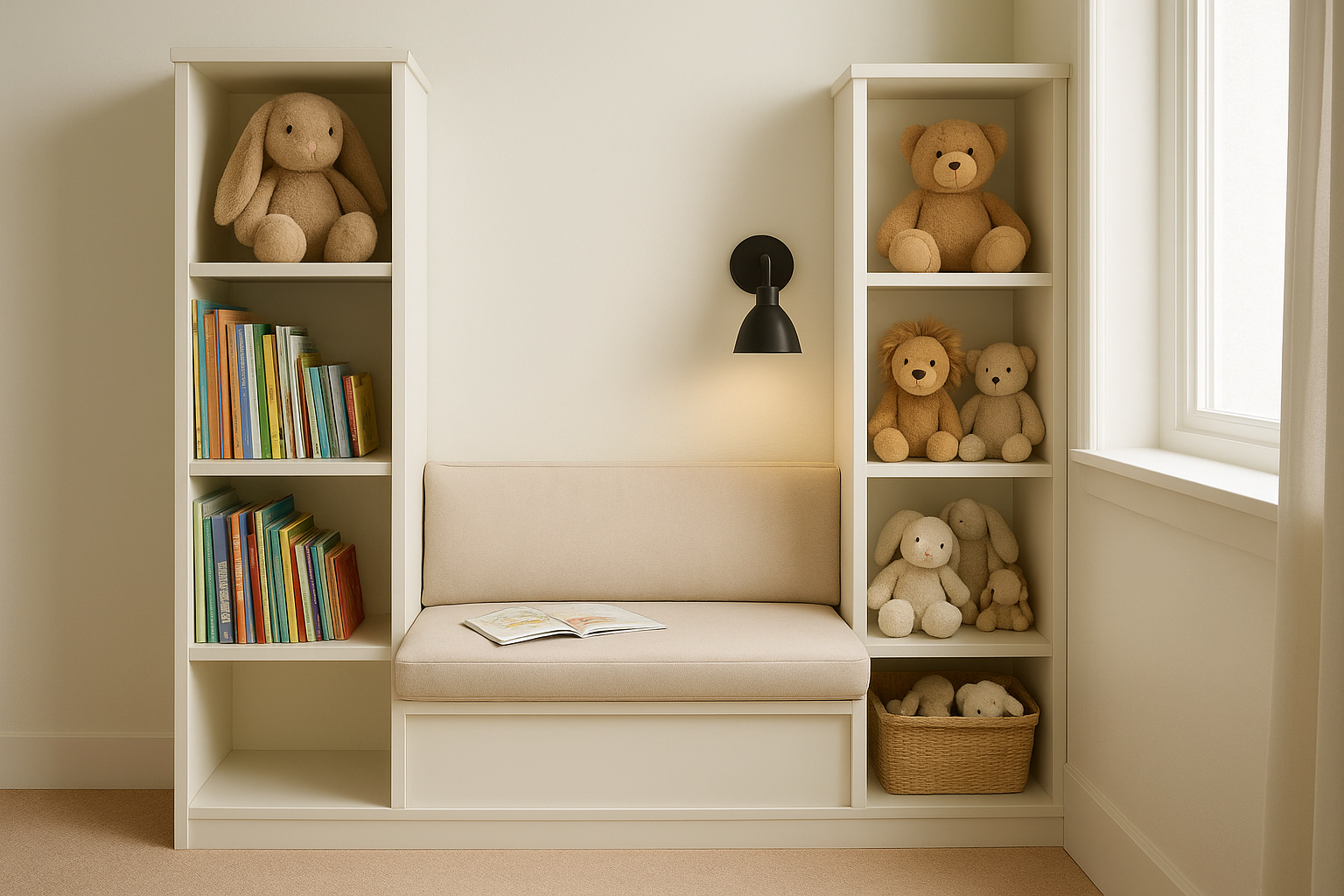
A reading nook shelf builds a small seating pocket right into the storage unit, usually a low bench or cushioned corner flanked by shelving on one or both sides. Instead of separating the reading spot from the toy organizer shelf, this design puts them in the same footprint, so a kid can grab a book or a stuffed animal without leaving the nook. It closes out this list as the pick for families who want storage to double as a destination, not just a wall of bins.
Key features
What separates a reading nook from a plain bench is the shelving wrapped around the seat rather than tucked underneath it, which keeps books and plush toys within arm's reach while a kid is sitting still. Shelves on either side are usually shallower than a standard cube, since deep plush toys and picture books both stack better in a wide, shallow slot than a narrow, deep one.
- Built-in bench or cushioned floor pocket flanked by open shelving
- Shallow shelf depth (20-30 cm) suited to plush toys and picture books
- Soft lighting or a reading lamp mount on some premium versions
- Low guard rail or lip on upper shelves to stop plush toys tumbling onto the seat
- Compact footprint that fits into a window bay, closet nook, or bedroom corner
A shelf that invites a kid to sit down gets used far more than one that just holds toys.
Best for
This style suits families who want a calm, dedicated spot for quiet play or bedtime stories, not just a storage wall for cleanup. It works well for preschoolers and early readers who already gravitate toward a favorite corner, and for parents furnishing a shared room where a defined nook helps one kid claim a personal space without a full room divider. Smaller bedrooms with an underused window bay or closet also benefit, since the nook fills dead space that a rectangular shelf would waste.
Materials & safety
Solid wood or plywood shelving holds its shape better than the light MDF sold in budget nook kits, especially on the shallow upper shelves that take the most daily handling. Confirm any cushioned seat uses a fire-retardant, child-safe foam and a washable cover, since spills and crumbs are inevitable in a spot meant for lingering. Check for rounded corners on any shelf edge at head height, since a nook invites kids to lean and lounge in ways a plain shelf doesn't.
Price range
| Configuration | Typical price range |
|---|---|
| Basic nook shelf, no cushion | €90-€140 |
| Cushioned bench with side shelving | €140-€220 |
| Solid wood, custom size or lighting | €220-€300 |
Custom sizing costs more but often the only way to make a nook fit an odd-shaped alcove or window bay properly.
Choosing the shelf that fits your playroom
Every option on this list solves the same basic problem, a floor full of toys and no clear system, but the right pick depends on your room and your kid's age more than any single feature. Match the shelf height to your child's reach, check that anything taller than knee-high comes with a wall anchor, and favor solid wood or plywood over particleboard if you want the piece to survive more than one kid's childhood. A toy organizer with shelf storage only works if your child can use it without help, so let that test override style preferences when the two conflict.
Small rooms, growing collections, and toddlers who need independence all point toward the same kind of build, low, open, and sturdy. If you want that combination in one Montessori-designed piece, browse KateHaa's collection and find the shelf your kid will actually use.